
By Cecil Egbele | Contributing Writer | California Local News Fellow
There was a time when NaTesha T. Johnson knew the Kern County Fair the way a lot of Black kids from Bakersfield knew it, as a rare treat carved out of a tight budget. Her mother, a single woman raising four daughters while putting herself through school, would gather just enough to give each girl about $20 in ride tickets. When the money ran out, they found other ways to stretch the day: the free stages, the livestock pens, the gospel celebration that drew the African American faith community together.
That little girl who once stood in line for food at the Friendship House and the MLK Center is now the chair of the Kern County Fair Board of Directors, the first African American to hold that position in the board’s 110-year history. NaTesha T. Johnson didn’t just find a seat at the table. She is leading it.
Johnson, who serves as executive director of Entrepreneurship and Workforce Development at Bakersfield College, sat down to talk with me about her historic milestone, her vision for the fairgrounds, and the message she hopes her journey sends to every young Black child in Kern County who is still counting their ride tickets.
Cecil Egbele (CE): You’ve been in Bakersfield your whole life. Tell me a little about your background.
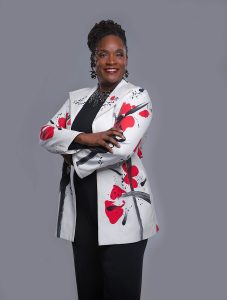
(Photo Courtesy of NaTesha T. Johnson)
NaTesha T. Johnson (NTJ): I’m a Bakersfield native, true and true. Every school you can think of, McKinley Elementary, Emerson Junior High, and Bakersfield High, I attended here. I also went to Bakersfield College and Cal State Bakersfield. I have Bakersfield blood running through me. It’s a blood of pride, because we have great pride in our community and the people in it.
CE: The fair is somewhere you’ve been going to since childhood, but the experience was very different back then, wasn’t it?
NTJ: Very different. I was raised by a single mother of four. Going to the fair was a big deal because we were low on income. We each had about $20 for rides. When those funds were exhausted, we stayed occupied with the free things, seeing the livestock, and watching the entertainment on the community stages. And we always had our gospel day. For me, the fair was about family, about reunion, a time when we could all come together and have a really good time.
My mom was putting herself through school to become a teacher while raising us. We stood in line for food boxes, the cheeses, the meats, the canned goods. We had the Friendship House and the MLK Center to help us. Without that village, I honestly would not be here today.
CE: And now you sit at the head of that same board. How does that feel?
NTJ: It makes me feel the full weight of where I came from. My lens as a child was about survival and joy at the same time, enjoying the fair with what we had. Now, as someone internally involved, my lens has expanded. I look at the fair, and I say: this belongs to the community. The community doesn’t look like one thing. It is a rainbow of people. My vision is to make sure we’re making an impact that reflects all individuals, all layers. I always say, we’re bringing the community back.
CE: How did you end up on the Fair Board in the first place?
NTJ: I was appointed by Governor Brown about eight years ago. It’s a governor-appointed position. Our job is to provide oversight to the Kern County Fairgrounds, and that is a 365-day-a-year responsibility. This is not just a fair-time thing. We are an event center for Bakersfield all year round. I chaired our facilities and business committee and served on other committees. Then I was blessed to be nominated and selected by our board to serve as chairwoman for the next two years.
CE: What are your top priorities in this role?
NTJ: Community first, always. I wear that hat because I come from the community, and the community helped raise me.
My second priority is educational awareness around agriculture. Kern County agriculture is number two in California, right behind oil. It’s important that this generation understands they’ve always had that in their DNA. I want to welcome them back to it, especially our urban kids who may not realize that agriculture is part of their story too.
Third is growth and sustainability. How do we keep bringing something new to the fairgrounds year-round? Whether that’s solar panels for parking or something we haven’t even imagined yet, being innovative and creative has to be a priority.
CE: You are the first African American chair in 110 years. What does that mean to you?
NTJ: My first thought, honestly, is: why did it take 110 years? It shouldn’t. We should not still be having “firsts” in 2026. Being the first means I have a responsibility, not just to sit in this seat, but to make sure I am not the last. I have to bring someone along. If you don’t see it, it’s hard to be it.
I stand on the shoulders of great women in this community, the Dee Slades, the Lily Parkers, the Catherine Jordans. They paved the way. And now it is my turn to do the same. So yes, it’s twofold: I’m proud and humbled, but I also keep asking, what are we going to do about it now that we’re here?
CE: What do you want young Black kids in Bakersfield to take from your story?
NTJ: That where you start does not determine where you finish. I grew up counting ride tickets at that fair. I stood in line for food boxes. My mother was doing everything she could on her own. And none of that disqualified me; in fact, all of it prepared me. It gave me empathy, it gave me drive, it gave me an understanding of what people in this community actually need.
I want every young Black child in Kern County to know that the table exists for them too. You don’t have to wait to be invited. You prepare yourself, you show up, you serve, and you bring others with you when you get there.
CE: Any final words for the community?
NTJ: Give leaders grace. Leadership is hard, not just because of the responsibility, but because it means carrying the hopes of people who are watching to see if someone like them can do it. I feel that weight. But I also feel the joy of knowing that a little girl who grew up the way I did can grow up to chair a 110-year-old institution. That is Bakersfield. That is what this community is capable of.
And if you’re tired of seeing the same people doing everything, step up. I will help you. If you’re not at the table, you’re on the menu. Somebody has to get it done. Why not you?
