
By Antonio Ray Harvey | California Black Media
Various youth organizations and youth-led initiatives participated in legislative advocacy days last month at the California State Capitol to amplify the voices of Black communities and help cultivate the next generation of leaders.
Among the organizations, the NAACP California-Hawaii State Conference youth councils and young people sponsored by the Black Women Organized for Political Action (BWOPA) engaged directly with state legislators, advocated for policy reforms, and gained experience in the legislative process.
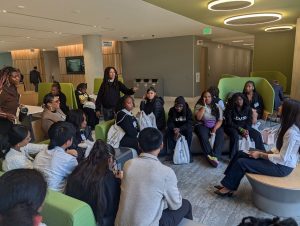
Wisdom O. Cole, the Senior National Director of Advocacy for the NAACP, told California Black Media (CBM) that the youth councils from across the state visited the capital city to monitor legislation that the organization has made priorities: from data centers that affect energy bills to voting rights, and the impact U.S. Immigration and Customs Enforcement (ICE) has on California communities.
“It’s important for young people to be in these spaces because it’s about building a legacy and a ladder of leadership,” Cole said. “Advocacy is a long-term process. We need to continuously revisit the table and consistently revisit the legislators to remind them to build power into the young people.”
Cole added, “Learning the process is important although, oftentimes, it seems difficult and arduous. Sometimes it feels like our legislative leaders are distant figures that we can’t touch or talk to. We have to remind our young people that these people work for you.”
Cole previously served as the National Director for the NAACP Youth and College Division, where he managed campaigns for over 700 youth and college chapters, focusing on student debt cancellation, police accountability in schools, and voter access.
Before members of the NAACP CA/HI youth councils from Stockton, Oakland, San Diego, Los Angeles, Long Beach, and other areas met with the legislators, they practiced, role-playing as the lawmakers and constituents.
They focused on three bills.
First on their agenda was California Senate Bill (SB) 1420, introduced by Sen. Laura Richardson (D-Inglewood). The bill focuses on election administration by enhancing voter education and procedures for handling vote-by-mail (VBM) ballots. Richardson is a member of the California Legislative Black Caucus (CLBC).
SB 1420 mandates regulations to promote “Sign, Scan and Go” options, allowing voters to turn in VBM ballots in person, and requires that this information be included in the state voter guide. It passed 7-0 in the Senate AppropriationsCommittee on April 20 but was placed in the suspense file for further fiscal review.
Next, the young people advocated for Assembly Bill (AB) 1537, authored by Assemblymember Isaac Bryan (D-Ladera Heights). It would bar peace officers from engaging in any part-time, or contract-based secondary employment or volunteering for the U.S. Department of Homeland Security (DHS), its contractors, or any entity involved in immigration enforcement.
AB 1537 passed out of the Assembly Public Safety Committee with a 5-3 vote on March 3. The legislation was placed in the Assembly Appropriations Committee’s suspense file.
Finally, they lobbied lawmakers on AB 2383, authored by Assemblymember Rick Zbur (D-West Hollywood). That legislation aims to protect residential electricity ratepayers by creating a special rate structure for “large energy use facilities,” such as data centers. As of April 14, the bill was approved by the Assembly Utilities and Energy Committee with a 16-1 vote. It has been referred to the Assembly Appropriations Committee.
Langston Notto Bennett, a member of the Los Angeles NAACP Youth Council, said AB 2383 intends to manage the massive energy demands of data centers fueled by the artificial intelligence (AI) boom.
The young man who will enroll at Morehouse College next fall, a historically Black College and University (HBCU) in Atlanta, learned something else about the bill that he shared with other youth.
“I never knew California as a whole was becoming a hub for AI. I always knew the San Francisco Bay Area was a part of the AI culture because a lot of companies are moving towards AI,” Bennett said. “I also learned that it takes a lot to understand these bills and to go up there to talk to legislators. It’s a powerful moment for sure.”
On April 27, BWOPA was at the California State Capitol for its annual Legislative Day of Advocacy plus and Action. The event was designed to connect members, youth, and leaders with state officials to advocate for policies affecting Black women, families, and communities.
BWOPA is a statewide non-profit advocacy organization in California, dedicated to training, empowering, and engaging Black women and youth in the political process. Founded in 1968, it is the oldest women’s political organization in the state with chapters concentrated in the Bay Area, Sacramento region, Central Valley, Southern California, and Solano County.
“BWOPA’s Legislative Day was a reminder that we don’t all have to be policy experts—we just have to be prepared, clear, and willing to use our voices,” the BWOPA Oakland/Berkeley Chapter posted April 28 on Instagram.