
By Cecil Egbele | Contributing Writer | California Local News Fellow
Every month, about 7,000 students line up at Bakersfield College’s Renegade Pantry– some even skipping class to wait for something as basic as a free bag of groceries. The campus pantry, funded in part by California’s Cal Food program, stocks fresh produce, perishable goods, proteins, and everyday staples that students can access at no cost using points tied to their student IDs. Some skip class to wait in line. Some leave empty-handed because the line closes before they reach the front.
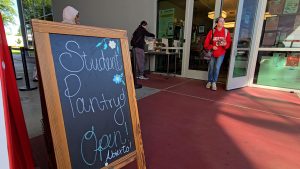
Photo Credit: Cecil Egbele
Now, a proposed cut to the state’s Cal Food program could make that already-strained resource nearly disappear.
California lawmakers are weighing a reduction to the Cal Food program from $80 million to just $8 million–a 90 percent slash that officials, advocates, and students say would have devastating consequences for communities across the state.
“We can’t go from 80 million to 8 million,” said Dr. Cesar Jimenez, Vice President of Student Services at Bakersfield College. “Food insecurity is absolutely real. Our students don’t have money to be able to purchase food.” The college serves more than 40,000 students, including veterans, parents, and working students.
The Cal Food program allows food banks to purchase California-grown produce and goods at significantly reduced costs. At Bakersfield College, a partnership with Community Action Partnership of Kern through the program brings fresh groceries and perishable goods to between 7,000 and 10,000 students every month at the Renegade Pantry.
Kelly Lowery, program administrator at the Kern County food bank, said last year, the statewide Cal Food program totaled $110 million. Kern County’s share came to roughly $1.4 million. Under the proposed cuts, he said that figure could drop to approximately $240,000.
“A lot of the shelves in this pantry are going to be almost empty,” Lowery said. “And the things that will be on the shelves will be very volatile- you can’t rely from month to month on what’s going to be there. It’ll just be dependent on what gets donated from grocery stores.”
The food bank currently serves around 50,000 families every month across Kern County, supplying school pantries, church pantries, and nonprofits throughout the region. Lowery said no sites will close- guided by a Haitian proverb the organization has adopted as its culture: “If there’s food for one, there’s food for two.” But he noted that in practice, that would mean less food per family, less reliability, and less stability.
Jared Call, Director of Public Policy and Advocacy for the California Association of Food Banks, is concerned that the cuts are happening at the worst possible moment. He said California food banks are already serving roughly 6 million people per month– up from 4.5 million at the height of the pandemic. Incoming federal cuts to the SNAP and Cal Fresh programs could strip as many as 750,000 Californians of food assistance, driving even greater demand to local pantries.
“It’s unacceptable that in the richest state in the country- and the state that produces most of the food for the country- so many people are going hungry,” Call said.
For students, the stakes are more than just logistics. Research from the UCLA Center for Health and Public Service and the national Real College Survey found that more than 70 percent of California college students are food insecure and links hunger directly to lower GPAs and higher dropout rates.

Photo Credit: Cecil Egbele
Khalfani Mackey, president of Bakersfield College’s Student Government Association, experienced those lines firsthand. He recalled the pantry closing even as he waited in line for his turn. He said many students would choose food over education.
“I was willing to stand in the line and not go to class that day,” Mackey said. “By the time I got to the door, they were closed because the line was so long.”
His message to legislators is direct: “Be human. If you value students’ trajectory, don’t cut it short by something as simple as food.”
