
By Antonio Ray Harvey | California Black Media
The controversy surrounding the California Board of Parole Hearings (BPH) and its decisions to grant parole to high-risk violent sex offenders and serial child predators dominated debate in the California Senate on June 1.
Despite strong opposition from Republican lawmakers, the California State Senate confirmed five of Gov. Gavin Newsom’s appointees to the Board of Parole Hearings for new three-year terms. The confirmations followed approval by the Senate Rules Committee and passed largely along party lines.
The confirmed commissioners are William Muniz, Michael Ruff, Rosalind Sargent-Burns, Mary Thornton, and Jack Weiss.
The Senate vote came after a lengthy and, at times, contentious debate over the board’s role in implementing California’s parole laws and evaluating incarcerated individuals for release.
During the floor debate, Senate President pro Tempore Monique Limón (D-Santa Barbara) acknowledged the sensitivity of the issue and emphasized the Legislature’s responsibility to balance public safety with legal and constitutional requirements.
“I want to acknowledge how difficult some of these decisions that were made today regarding our parole commissioners and the role that both commissioners and this house have to take in order to strike the right balance between constitutional safeguards and the risk to our most vulnerable, all with one goal: keeping the public safe and protecting the public,” said Limón.
At the center of the controversy is California’s Elderly Parole Program, established under Penal Code Section 3055. The program allows incarcerated individuals who are at least 50 years old and have served 20 consecutive years in prison to be considered for parole, regardless of the crime for which they were convicted.
Critics argue that the law has allowed individuals convicted of some of the state’s most serious offenses, including child molestation, rape, kidnapping, and murder, to become eligible for release.
Republican senators attempted to block the confirmations, citing public outrage over recent parole decisions involving convicted child abusers and serial sex offenders.
Among the cases drawing the most attention is that of Gregory Lee Vogel, 57, who was convicted in 1999 and sentenced to 355 years to life for nearly 30 counts of kidnapping and child molestation involving multiple young boys. In November 2025, a two-person parole panel recommended Vogel for release under elderly parole guidelines. You
Another case frequently referenced during the debate involved David Allen Funston, 64, who received three life sentences for a mid-1990s crime spree involving the kidnapping and sexual assault of seven children — six girls and one boy — in the Sacramento area.
On the Senate floor, Sen. Shannon Grove (R-Bakersfield) noted that Funston had “expressed interest” in relocating to her district in Fresno upon release. However, Funston was arrested by Placer County authorities on a no-bail warrant just before he was scheduled to be released on elderly parole through the California Department of Corrections and Rehabilitation (CDCR).
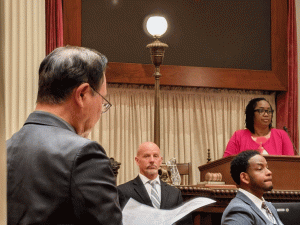
The debate intensified when presiding officer Sen. Akilah Weber Pierson (D-San Diego) interrupted Grove as she began criticizing appointee Jack Weiss during the confirmation discussion of a different commissioner.
“Sen. Grove, I’m so sorry. I know you wanted to work with all of us and do everything all at once, but since you’re specifically now talking about someone who hasn’t been presented yet, could you wait?” asked Weber Pierson, chair of the California Legislative Black Caucus (CLBC).
Grove responded by saying, “Absolutely, Madam President, I will present my comments again on Mr. Weiss. But I respectfully ask for a ‘no vote’ for this individual before us right now, Michael Ruff, who voted to let Funston out of prison.”
The Board of Parole Hearings consists of 21 full-time commissioners appointed by the governor and confirmed by the Senate.
Commissioners evaluate a range of factors to determine whether a person poses an unreasonable risk to public safety. The board plays a particularly significant role in reviewing cases involving violent offenders, including those convicted of sexual crimes.
Supporters of the confirmations argued that commissioners were carrying out their legal responsibilities by applying laws enacted by the Legislature.
Sen. John Laird (D-Santa Cruz) said the commissioners were being unfairly criticized for faithfully implementing state law. Under existing law, parole panels must consider factors such as an inmate’s advanced age, length of incarceration, and diminished physical condition when evaluating parole suitability.
“(The laws) are faithfully implemented by this board, and yet in their confirmation, they are criticized for the law rather than for the fact that they are faithfully following the law,” Laird said.
Laird also pointed to data showing that the commissioners under consideration approved parole at lower rates than the board as a whole.
“If you look at the statistics that were provided to us, overall, the commission has a grant rate of roughly 30% between the number of grants of parole and the number of denials of parole. Of these five members that we considered today, every one had a grant rate lower than the average of the entire commission.”
Meanwhile, lawmakers from both parties are pursuing reforms to California’s Elderly Parole Program in response to growing concerns about the potential release of convicted child sex offenders and other violent criminals.
Assembly Bill (AB) 2727, authored by Assemblymember Stephanie Nguyen (D-Sacramento), passed the Assembly unanimously on May 28 by a 70-0 vote and is now awaiting consideration in the Senate.
“Parole decisions are not taken lightly by this house, nor by any members,” Limón said. “As a mother, I know how important it is to ensure that the public has confidence in the decisions that this body makes. This house is advancing bipartisan legislation to ensure that we’re adding discretion and reviewing the work of the commissioners for transparency and for public safety purposes.”