
By Antonio Ray Harvey | California Black Media Matthew Parham, a professional voice actor, was among dozens of artists and creators from across California who traveled to Sacramento to witness the Senate Privacy, Technology and Consumer Protection Committee vote in favor of legislation that would require developers of generative artificial intelligence (GenAI) models to disclose the copyrighted materials used to train their systems. Authored by Assemblymember Rebecca Bauer-Kahan (D-Orinda), Assembly Bill (AB) 412, the AI Copyright Transparency Act, passed the Senate committee with a 6-2 vote on June 8 at the Capitol Annex Swing Space. The measure now moves to the Senate Judiciary Committee for consideration. Parham told California Black Media (CBM) that he serves as director of operations for the National Association of Voice Actors (NAVA), a coalition of performers who use their voices to portray characters, provide narration or create sound effects. “Voice actors are in a unique situation. No one in America owns their right to their voice. You can legally steal someone’s voice,” Parham told CBM. “This bill is essential. There is no legal protection for your voice right now.” Parham elaborated on the challenges voice actors face in protecting their work. “For example, I voice video games. I can’t copyright it because I’m not the developer, but my biometric data is contained within that video game,’ Parham added. Artists and creators from Los Angeles, San Diego, Oakland, San Francisco, Sacramento and other communities attended the committee hearing. AB 412 is co-sponsored by the Screen Actors Guild-American Federation of Television and Radio Artists (SAG-AFTRA), which represents approximately 160,000 media professionals worldwide. Bauer-Kahan, SAG-AFTRA and the Transparency Coalition argue that the bill does not alter federal copyright law. Instead, AB 412, supporters argue, establishes state-level transparency requirements. At its core, AB 412 would require GenAI developers to document the copyrighted materials used to train their models, including systems capable of replicating a person’s vocal characteristics to generate synthetic speech that sounds like professional voice talent. “I introduced AB 412 for one simple reason. I believe in copyright law, and I believe in the right of copyright owners to have a right to know whether their materials are used to train GenAI,” said Bauer-Kahan, who is an attorney. According to Parham, AB 412 would allow voice actors and other creators to request comprehensive lists of their registered works used in AI training datasets. The bill would also authorize creators to sue developers who refuse to provide that information. “AI scrapes from everyone’s face, voice, paintings, photographs, and everyone’s music,” Parham said. “And now they are trying to sell it back to us without any ownership at all, claiming eminent domain over things they didn’t create.” AB 412 was retained as a two-year bill after stalling in the Senate last year. Bauer-Kahan told CBM on June 11 that she accepted committee amendments that narrowed the measure by “removing prescriptive technical language” to make compliance more feasible. Bauer-Kahan emphasized that the AI Copyright Transparency Act does not interfere with federal copyright law. “Most copyright laws are in the federal purview. So, whether the rights holder has a right to be protected from models being trained under federal copyright laws is not for us to determine here in California,” Bauer-Kahan said. “However, transparency is not in the federal purview. That, we can actually do.” Not everyone supports the measure.
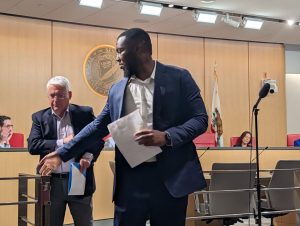
Chudi Iregbulem, a former Amazon engineer and disc jockey, founded Beatmatch, a Los Angeles-based mobile dating and social networking app that connects users through shared musical interests and alerts them to concerts and events in their area. Iregbulem told the Senate committee he opposes AB 412 because “it imposes costly and complex requirements that could significantly harm startups” like Beatmatch. He added that he respects copyright protections and that Beatmatch does not copy songs or use them to generate music for the platform. “We’re a team of three. We have over 10,000 users and startups like mine don’t have the funds or the bandwidth to meet compliance requirements,” Iregbulem said. “Even the cost of hiring lawyers to simply determine which AI outputs may no longer trigger compliance with the law would be substantial.” Parham said he is deeply committed to protecting and advancing the entertainment industry. During his career, he has performed voice-over work for brands and organizations including Nike, Marvel, ESPN, Amazon and Shakey’s Pizza Parlor, helping promote products and services through persuasive communication, tone and pacing. If AB 412 becomes law, Parham said, voice actors and other creators would finally have a way to determine whether AI companies used their protected performances to train artificial intelligence models. “I’m essentially a blue-collar worker. I put in my 40 to 50 hours every week to make enough to pay my rent,” Parham told CBM. “It’s not about being rich and famous. It’s about loving the art and having the right to protect that art.”