
By Cecil Egbele | Contributing Writer | California Local News Fellow
Nearly two dozen men from diverse backgrounds gathered Friday at Hodel’s Country Dining in Bakersfield for the inaugural It Hurts to Heal: The Brotherhood Experience, part of a local effort to encourage men to talk openly about mental health and seek support before reaching a crisis.
The event was organized by InspireMe Counseling & Wellness Center and It Hurts to Heal, LLC, a community organization focused on promoting emotional healing through conferences, workshops, and public conversations in Bakersfield. Research says men are less likely to seek therapy because of cultural expectations around masculinity.
While women make up nearly two-thirds of Medi-Cal mental health service users in Kern Health Systems, men account for just over one-third. At the same time, men in Kern County die by suicide at more than three times the rate of women. These statistics highlight the importance of efforts like the It Hurts to Heal effort to encourage men to seek support.
Over the course of three hours, licensed professionals led attendees through exercises and lectures meant to connect men with resources and support.
The evening opened with an intimate, raw exercise that immediately dismantled pretense.
Attendees were asked to write anonymously on index cards—on one side, how they present themselves to the world, and on the other, the unspoken burdens they carry around. As Dr. Niesha Davis-Massey, a clinical therapist and founder of InspireMe Counseling & Wellness Center, read the responses aloud, the stark contrast between public perception and private pain filled the room.
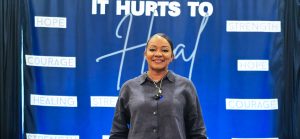
While men wrote that they present as “calm, happy, confident, and put-together,” the flip side revealed a crushing reality: “fear, self-doubt, financial pressure, imposter syndrome, grief, guilt, gambling struggles, and feeling expendable or replaceable.”
“Do you all hear the commonalities in here?” she asked. “One of the things I noticed for guys is that you feel like you have to do this by yourself, and you feel like you have to carry this alone, because you have to be the man.”
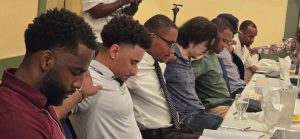
That exercise set the tone for the night, but the message really landed during “The Strong Don’t Get a Break” by Xania Monet. Men reached over and put a hand on the shoulder of the guy next to them. The song played over the room, creating a vulnerable atmosphere. The lyrics made one thing clear: You don’t have to hold everything up by yourself. You’re allowed to put it down.
Licensed Clinical Social Worker Theodore Richard addressed the clinical presentation of depression in men, noting how emotional pain frequently masks itself as irritability, chronic physical aches, hyperfixation on work, or substance misuse. He tackled the deep-seated cultural mistrust toward the medical field and the generational myths surrounding therapy, encouraging men to dismantle the expectation of having to “tough it out alone.”
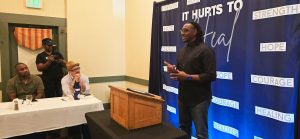
Keynote speaker Javon Kemp, a licensed professional clinical counselor, built his talk around a single image: the scar. He used physical injuries to illustrate psychological trauma. Kemp told the room about the television that fell on him as a toddler, the gravel that tore open his knee at age 10, wounds whose pain faded but the marks remained. Emotional wounds, he said, work much the same way.
“The wounds are not to define us. The wounds are not to hinder us, but they are a part of our story,” Kemp shared. “You can’t always cover up the wound– you have to let it breathe. If you smother it under a Band-Aid forever, it gets infected. We have to expose it, give it air, and allow it to become a part of our overall story.”
He engaged the room to name what they still carry. One man described feeling overlooked and constantly uprooted as a child, never asked what he wanted. Another traced a wound back to his parents’ divorce at age five, and his fear of repeating it in his own marriage. A third described his mother’s addiction after his parents separated, and the resentment he still wrestles with. A fourth shared the pain of being abandoned by his wife while raising children alone.
Kemp acknowledged their openness and said that healing is a process requiring time, intention, and honesty.
Complementing Richard, therapist Greg Ragle broke down the concept of “healthy masculinity,” contrasting emotional suppression with emotional intelligence. “True strength is not the absence of emotion, but the ability to acknowledge emotions, regulate behaviors, and build healthy relationships,” Ragle emphasized. He reminded attendees that showing humility, setting boundaries, and engaging in self-care are essential expressions of a mature, grounded man.
Injecting humor into the heavy conversations, comedian DeMar “DJ” Johnson joked about marriage, fatherhood, and the everyday pressures of manhood.
For the men in attendance, the event provided relief in knowing they don’t have to be picture-perfect all the time.
Jaubrae Dixon, founder and CEO of C.H.A.N.G.E.S., noted how crucial it is for men in Bakersfield to be proactive about their mental health. “We want to feel like we have it all together, but sitting in a space like this allows us to see that we don’t, and that it’s okay,” Dixon reflected. “I’m walking out knowing I don’t have to carry the mask anymore.”
Similarly, Braden Gordon, a local youth case manager and graduate student in psychology, highlighted the evening’s core takeaway: “Our wounds aren’t us. They don’t define us; they’re a part of our story, and it’s not the end. We accept them, deal with them, heal them the correct way, and keep moving forward.”
As the inaugural brotherhood experience ended, Davis-Massey believed the success of the night isn’t measured in crowd size, but in lives changed.
“If one person leaves with a message that provokes them to start their healing journey or change their life, that is success,” Davis-Massey said. “You are not a burden. You are not alone. And you matter more than what you give away.”
Davis-Massey said she is already planning the third annual It Hurts to Heal conference for women, and hinted that the brotherhood gathering will return.
