

This story was produced for the USC Center for Health Journalism’s Ethnic Media Collaborative.
By Cecil Egbele | Contributing Writer | California Local News Fellow
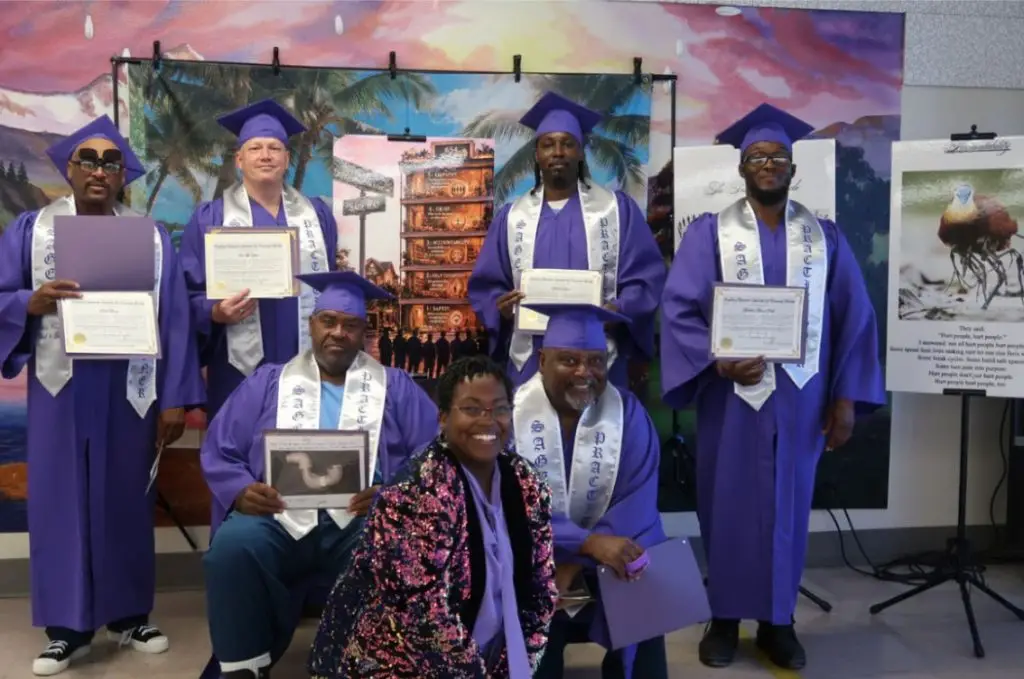
In a corner of a large visiting hall at California State Prison, Corcoran, six men in purple caps and gowns sat in a circle on an early August afternoon, waiting to graduate.
The ceremony did not reflect a typical academic exercise, but the culmination of a unique and emotional 12-week journey through trauma, grief, accountability, and healing known as SAGE.
Serving sentences for crimes ranging from sex crimes to murder, the graduates took turns describing the impact the course had on their incarcerated lives.
“In the prison system, they see population,” Clifford E. Lewis Jr. 49 said, referring to the prison staff. “But groups like this help create community. To be rehabilitated, you have to learn how to move from a population to belonging to a community.”
“Before now,” Lewis continued, “I saw each person here as an inmate, but now when I pass by, I don’t see another inmate. I see a brother.”
Taiwan Reed, 43, who said he joined as a survivor of childhood abuse, said the course “helped to heal from the trauma I had as a kid.”
SAGE is among a patchwork of programs across California prisons where experts say there is little structured help, therapy, or processing for grief and trauma, despite high instances of both among the incarcerated.
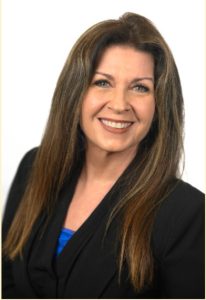
“Prison doesn’t stop for grief,” said Nena Messina, a retired UCLA research criminologist who has studied trauma programming in California prisons since 2014. “There’s no compassion.”
Eddie Brown, 64, who said he has served 26 years in other facilities including Corcoran, said the course has, “taken away my anti-social behavior.” He added: “I am more self-aware now.”
Teresa ‘Tree’ Moses, a 43-year-old woman with short micro-curls wearing black pants and a colorful, multi-colored sequined jacket, ran the room. Everyone calls her Tree. Her organization, Tree’s House Soul 4 Sole, champions SAGE, or Standing And Guiding Experiences.
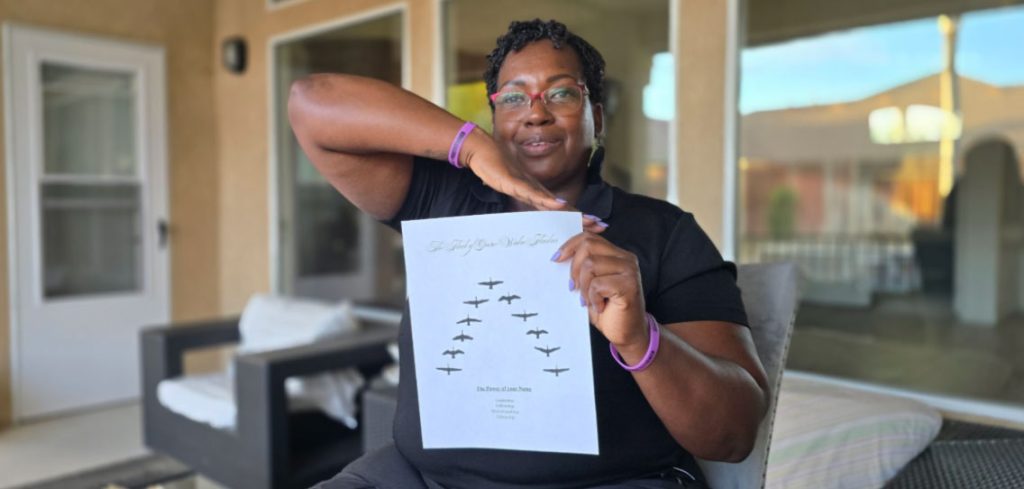
“I do soul work so that the sole of your feet can continue to maneuver,” Moses said. “Which means we navigate tough terrain of trauma, grief, childhood experiences, so that no matter where you go in life, your feet is always able to move.”
Moses launched SAGE in 2022, six years after she was released from a decade of custody and court-ordered treatment related to the death of her 8-year-old son.
Raijon Daniels died in 2006 after years of abuse, which the Contra Costa County coroner attributed to battered child syndrome. Moses, who was then 23, was charged in connection with his death. In 2009, three court-appointed doctors concluded Moses was legally insane at the time of the abuse. A judge found her not guilty of murder by reason of insanity and committed her to Napa State Hospital.
“I spent three and a half years in jail fighting this case, fighting being the murderer of my eight-year-old son,” she said. “I was held accountable, and I have served the time.”
In 2013, a judge allowed Moses to leave the hospital for state-supervised outpatient treatment, and in December 2016, court records show she was granted unconditional release.
“Honestly, my son never had a chance because I had so many different wounds from childhood that had gone unaddressed,” Moses said. She said she was sexually abused by relatives starting when she was 5, and that she became a mother at 14.
Moses said she grew up never understanding what a healthy relationship looked or felt like, or how to speak up for herself and ask for help. Violence and abuse were normalized, she said of her rough upbringing. “It cost me to not know how to use my voice and ask for help…It cost me to normalize what abuse was in the household…It cost me everything.”
Moses said she built SAGE’s curriculum from the pain of her own life’s journey.
While at Napa State Hospital, Moses enrolled in a six-month decision-making course, during which the facilitator asked Moses to read a book on making better choices and teach a class on the findings herself; Moses spent the next two and a half years co-facilitating these courses alongside the hospital’s three teachers.
“That is where my roots started growing,” she said.
After Moses’ release, she enrolled at Coastline Community College, earning associate degrees in psychology and in social and behavioral sciences.
“I became the ward president over every unit that I lived on there, because somehow I can get 80 patients in a room to have a conversation and be able to advocate for them.”
Filling the Gaps Grant by Grant
In 2022, the American Psychiatric Association added prolonged grief disorder a severe, persistent grief that lasts for more than 12 months and disrupts everyday functioning — to the DSM-5 as a formal condition.
California’s prison mental health system has been under federal court supervision since a class action filed in 1990 on behalf of prisoners with serious mental illness, a case now captioned Coleman v. Newsom. That oversight has produced a public record of what the state provides, including levels of care, staffing, crisis beds, and suicide prevention, through a court-supervised program guide and periodic monitoring reports by a court-appointed Special Master.
The Ninth Circuit has also described persistent problems with staffing and the state’s compliance with court-ordered mental-health requirements. While the Coleman case covers prisoners with serious mental illness, trauma and grief are more widespread and often harder to recognize, experts say, which makes them harder to treat.
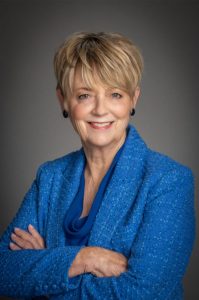
Stephanie Covington, co-director of the Center for Gender and Justice, whose trauma-focused programs are used in correctional settings, said people entering the criminal justice system have higher rates of trauma histories than the general population.
“Corrections needs to become trauma informed,” she said. “They need to have trauma-informed programming in every institution, just like they have substance use programming.”
“Some people may not even recognize what they have experienced as trauma,” Covington continued. “When adversity has been part of someone’s life for years, it can seem normal even when it affects how that person responds to stress, conflict, or relationships.”
Covington’s program, Exploring Trauma+, is a six-session course delivered by trained peer facilitators who are themselves serving long sentences.
Nena Messina, who runs the non-profit Envisioning Justice Solutions, led the first randomized controlled trial of a trauma intervention for men incarcerated for violent offenses in 2014. The trial was conducted at Corcoran.
“Often there’s punitive reaction to normal displays of grieving behaviors,” said Messina.
She said incarcerated people often have to hide or suppress signs of grief, like crying or withdrawing, to avoid consequences.
Of the 221 men in the Corcoran trial, 131 men completed the course, showing significant improvement over the remaining control group on 11 of 13 trauma-related measures like anxiety, depression, psychological well-being, current traumatic distress, and several measures of anger.
“Not only do they impact their trauma symptomology and their trauma-related psychological symptoms, but they’re reducing their anger and aggression and hostility as well,” Messina said.
California pays for some of this work, but the California Department of Corrections and Rehabilitation (CDCR) does not directly fund trauma or other programs for residents, Messina said.
The CDCR funds outside nonprofits through competitive grants, totaling $4 million a year. SAGE is one of about two dozen programs funded in the current three-year cycle, which began in July 2025. So is Covington’s program Exploring Trauma+.
The continuation of these services depends solely on community organizations securing additional funding; Messina explained, who continues to advocate for a dedicated funding source for these programs.
“For a decade, I have been writing the proposals on a hamster wheel to keep things going, when they should be ‘in place’ as regulations,” Messina said, as “policy to direct treatment needs.”
Inside the Curriculum
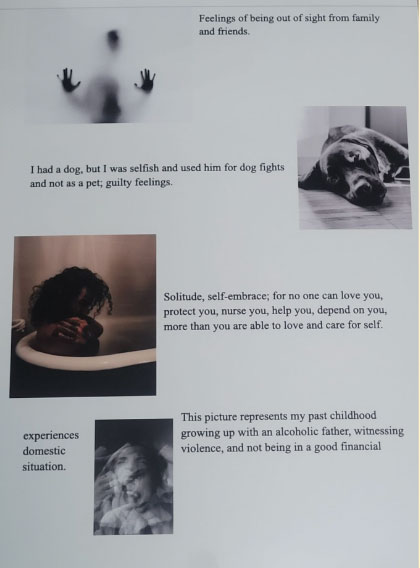
The SAGE program combines pictures, writing assignments, animals, group exercises and personal stories to get participants to examine experiences they may have never had the language to describe.
Moses said participants climb what she calls a pyramid of restorative transformation: safety, identity, accountability, grief, and empathy. Those who complete the course are not called graduates, but ‘practitioners’ because Moses believes that the work does not stop at 12 weeks.
Eight digital posters were hung on the walls in the prison room where the six men gathered on this August day.
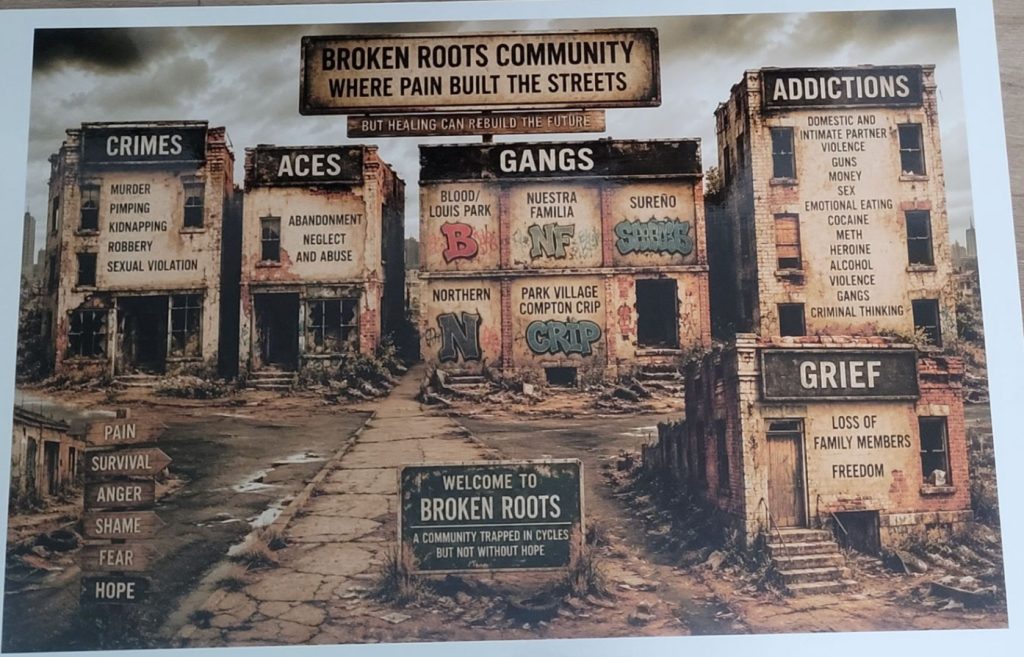
One of the posters featured a neighborhood of burned-out buildings labeled Broken Roots Community. The image is meant to convey the enduring realities of growing up in a world of crime, gangs, addiction, grief, and other adverse childhood experiences.
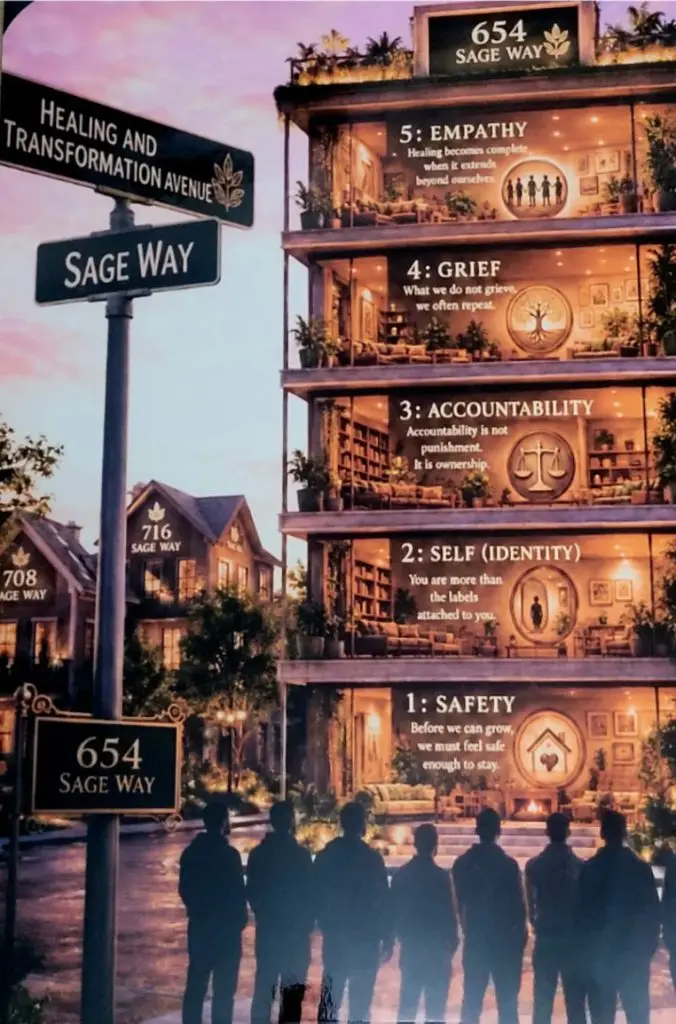
Another drawing showed a well-lit, five-story, plant-laden building on a street called Sage Way. Each floor carried words of hope.
SAGE is built as the five floors shown on the Sage Way poster. Most correctional programming, Moses said, opens at the offense and works backward.
But Moses said she does not begin by asking participants what crime brought them to prison. Instead, she asks them to examine what happened leading up to the crime, what they learned to do to survive the violence around them, and ultimately, how their actions have affected those around them.
“I didn’t get to see my son graduate, I didn’t get that experience,” Moses said. “I didn’t get to pour my best self into him. All I had was pain and trauma and grief and all of these experiences. And I poured what I had.”
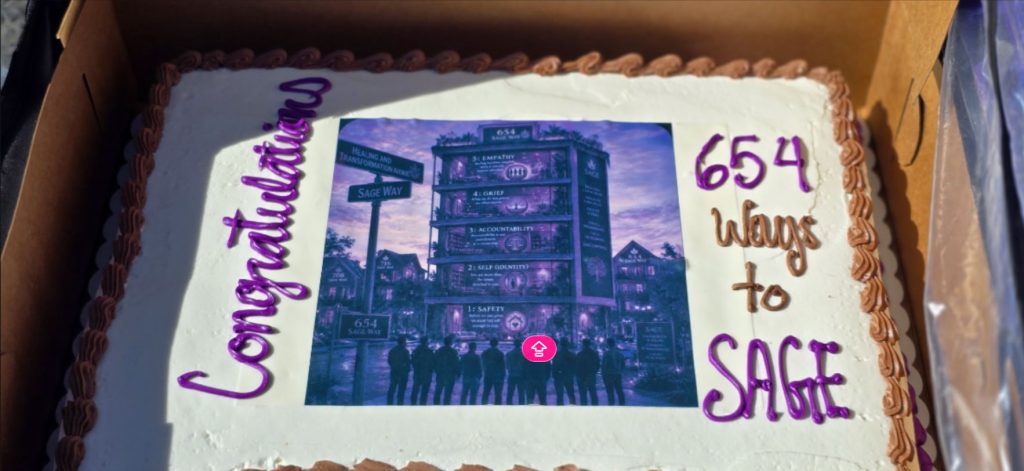
Moses said she is grateful for the opportunity to channel her pain into helping others heal.
“If you can’t use words, use pictures. If you can’t use pictures, use textures. If you can’t use textures, use colors,” Moses said. “There is a way to express, so that nobody’s voice is ever left behind. And you don’t have to stay in that pain.”
Moses begins each 12-week program by reciting a line by writer Isabella de Bruno: If you do not heal old wounds, you will bleed on people that never cut you.
“Sometimes you’re surviving from a place of pain,” Moses said, “and you’re not able to see how that’s rippling an impact of pain across the community and future generations.”
“And the truth is, I absolutely miss my son,” she said. “But I also understand that I have a room full of someone else’s sons, and I’m going to give [them] the best that I have.”
For Moses, creating a space for raw emotional expression is essential because the prison environment forces individuals to lock away deep, personal grief.
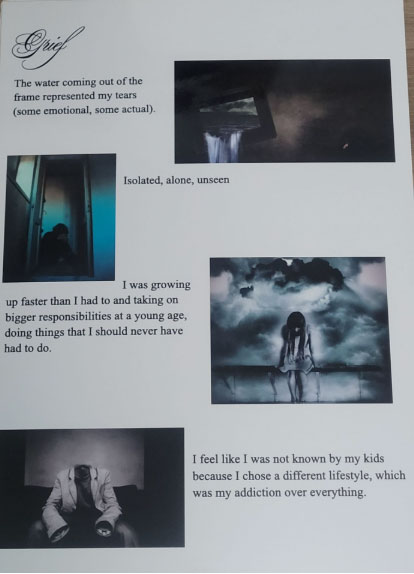
“It’s not just the loss of freedom that people are experiencing inside,” Moses said, “but not being able to go to Big Momma’s funeral, not being able to watch their children grow up. And then not having space where you feel welcome enough and safe enough to even express it.”
Moses tells participants that crying is not weakness.
“I believe crying is a libation,” she said.
Moses has proposed extending the SAGE experience to family members so that people returning home and those waiting for them can develop a shared vocabulary and resources to navigate difficult conversations.
Marqese Clark, another inmate at Corcoran, said he enrolled in SAGE because of grief and loss he experienced while incarcerated. He has since begun passing on the lessons of the program to other men, including writing two new curricula — one on decision-making and the other on relationships — for folks to use when he is released.
“Attending this program makes me feel like a therapist now,” Clark said. “I talk to some of the men here, helping them and myself not to repeat the same cycle.”
All six men remain incarcerated.
