
By Cecil Egbele | Contributing Writer | California Local News Fellow
Interfaith service at Dignity Health Arena blends prayer, music, and family stories.
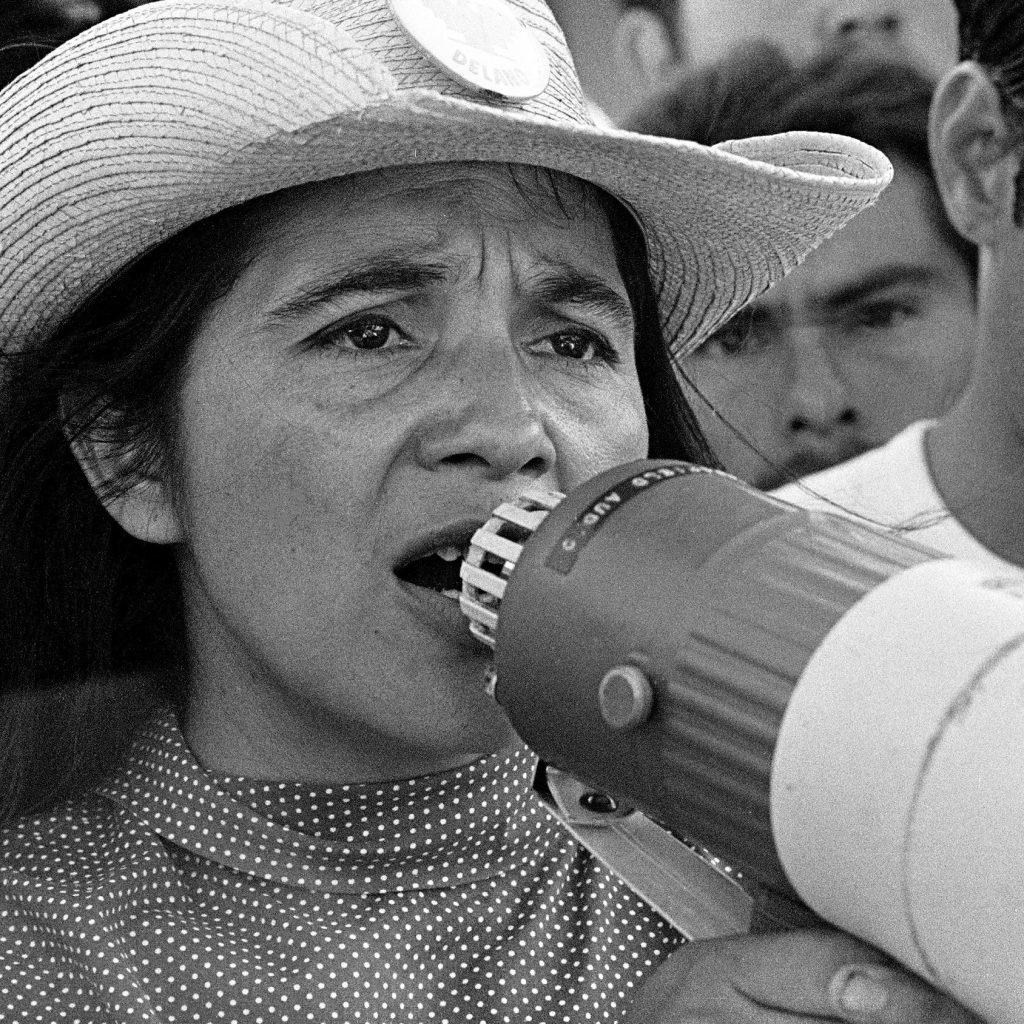
Thousands gathered at Bakersfield’s Dignity Health Arena on Nov. 20 for an interfaith service in memory of Dolores Huerta, a giant of the farmworker labor movement.
With Huerta’s wooden casket set before the stage, numerous faith leaders, family members, and elected officials – including incoming California Gov. Xavier Becerra and former President Bill Clinton – extolled the virtues of a powerhouse woman whose rallying cry “¡Sí, se puede!” – “Yes we can” – resonates with generations of social justice activists.
“Dolores didn’t just chant ‘People Power,’” Pastor Traco Matthews said. “She personified those words.”
Many faiths, one farewell
Huerta died on Oct. 28 at her Bakersfield home at the age of 96. The cause was cancer.
Her memorial service included prayers and blessings from representatives of Christian, Sikh, Jewish, Muslim and Hindu traditions, alongside Indigenous spiritual leaders. Though their prayers and practices differed, their messages converged around a shared belief in human dignity, compassion and service to others.
Indigenous leader Leonard Manuel Jr. offered prayers and chants for Huerta’s soul. He recognized her contributions to farmworkers, unions and children, describing her wisdom as something that would continue to pass from one generation to another.
Chanting with his granddaughter, Manuel Jr. said, “Songs are medicine, songs are prayer.”
Pastor Matthews, who offered a prayer in the Christian tradition, drew from Proverbs 31:8: “Speak up for those who cannot speak for themselves. Ensure justice for those who are being crushed.”
He related the passage to Huerta’s lifelong advocacy for people whose voices were often overlooked.
Rabbi Susan Goldberg of the Nefesh community in Los Angeles explained the Jewish phrase, “May her memory be for a blessing.”
“We intentionally make her memory be for a blessing when we think, ‘What would Dolores do?’, and do it in those situations again and again,” Goldberg said.
Aziza Hasan, executive director of NewGround, an interfaith organization in Los Angeles, read from the Quran and prayed that those gathered remember “that justice is never won by a solitary soul, but built collectively by those who uplift one another.”
Sudarshan Kapoor, professor emeritus at Fresno State, recalled Huerta’s visits to the university’s peace garden.
He led the crowd in one of Huerta’s famous chants: “Who has the power? We have the power.”
‘Our mother’s first committee’
Huerta’s children shared memories of the woman beyond the microphone.
Lori Huerta de Leon, her eldest, thanked the leaders who made it possible for Huerta to lie in honor at the state Capitol in Sacramento on Monday. She described her mother as a skilled organizer, savvy political strategist, motivating speaker and lover of jazz.
“Charlie Parker was her favorite,” she said.
Other family members recalled their days as children passing out union leaflets in the grape fields of Coachella, the family’s New Mexico roots stretching back 14 generations, and negotiations in which Huerta chose only to interpret so that the farm workers would learn how to speak up for themselves.
One family member remembered praying with Huerta in her final days; after the prayers, Huerta asked them to pray for everyone else who is hurting.
Other family members recalled the children passing out union leaflets in the grape fields of Coachella, the family’s New Mexico roots stretching back 14 generations, and negotiations in which Huerta chose only to interpret so farmworkers could speak for themselves. One remembered praying with Huerta in her final days, when she asked that they also pray for everyone else who was hurting.
Her daughter, Camila Chavez, executive director of the Dolores Huerta Foundation, recognized that the family’s deepest mourning might begin after the crowds had gone and public attention faded.
“People may expect us to fill her shoes, but she’s going to be buried with her shoes,” she said. “It’s going to take all of us here and there that are viewing us to fill those shoes.”
Camila Chavez said the responsibility of carrying forward her mother’s work belonged not just to the family but to everyone committed to human rights, dignity, justice and peace.
‘May we continue the work’
Family and friends led a litany for causes close to Huerta’s heart, including farmworkers, immigrants, women and girls, LGBTQ+ people, voting rights, children in war zones and the Earth. After each petition, the arena answered: “May we continue the work.”
The Rev. Jaquie Fernandez followed with a litany of gratitude and a set of commitments, saying, “The true measure of power is not whom it can control, but whom it can uplift.”
In the final farewell, three Catholic clergy members blessed and sprinkled holy water over Huerta’s casket in a funeral rite recalling her baptism and Christian faith.
“God of compassion and love, you knew her before the world knew her. Receive her into everlasting peace,” prayed Fr. Miguel Bustos.
Celebration of life
During the celebration of life ceremony, later in the day, more tributes and musical performances filled the air for four hours.
Xavier Becerra, a former California attorney general who will assume office in January as the state’s first Latino governor, credited Huerta with helping make his rise to public service possible.
“I know why I’m here. I know how I got here,” he said. “Dolores demanded it.”
Attorney General Rob Bonta, joined by his mother, Cynthia Bonta, said his family lived in a trailer at La Paz, the United Farm Workers headquarters, where his parents organized alongside Huerta.
“I learned that people power is the most potent power that there is,” he said.
Former president Bill Clinton, who sent in a video tribute, said: “Huerta gave everything because she knew that the people she was fighting for couldn’t afford for her to give up, so she never did.”
Randy Villegas, the representative-elect of California’s 22nd Congressional District, said earning Huerta’s endorsement “meant more than any endorsement I will ever receive from any organization or party.”
He urged those gathered to honor Huerta by continuing to organize and fight for justice as he rallied the crowd with the chant of the day, “¡Sí, se puede!”
