
By Cecil Egbele | Contributing Writer | California Local News Fellow
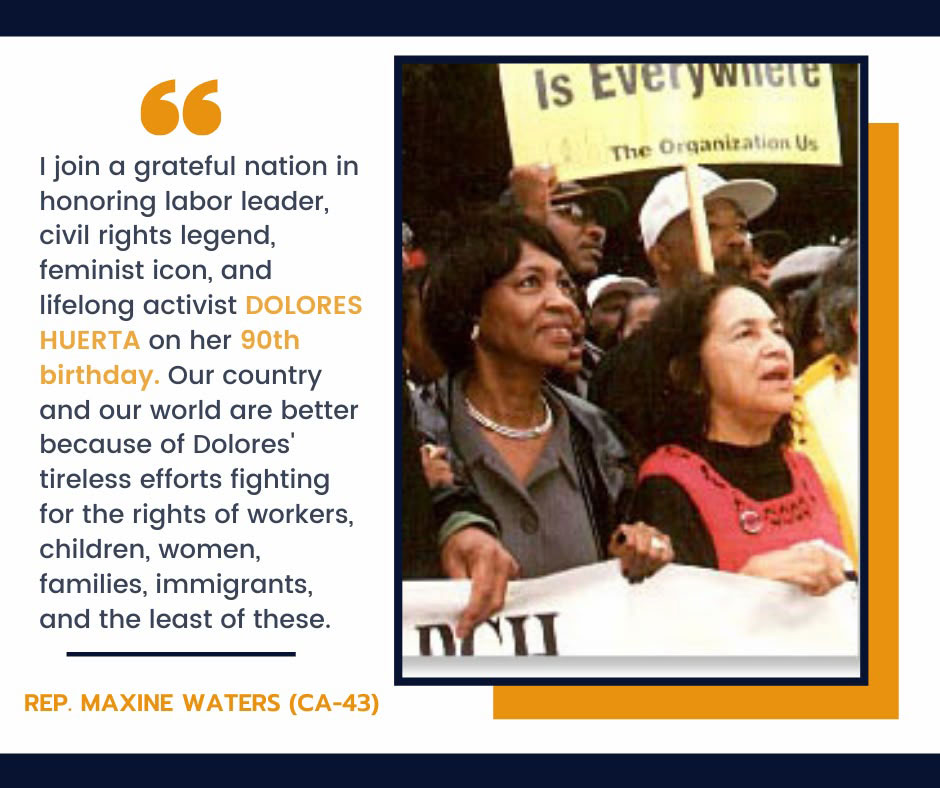
Congresswoman Maxine Waters (D-CA-43) said nothing was going to keep her from Dolores Huerta’s celebration of life.
“No matter what it took, if I had to walk to Bakersfield, I was going to get here,” Waters told the Bakersfield News Observer during an interfaith memorial service for Huerta on Nov. 20 at Dignity Health Arena.
Waters said that when she served in the California State Assembly, Huerta “used to walk the halls” lobbying for farmworkers, many of whom were sleeping on the ground without decent housing.
“She was there working for legislation to change the way the state of California dealt with farmworkers,” Waters said.
Waters, 88, called Huerta “a woman of impeccable integrity, who really loves people,” and someone who spent her life trying to create a better life for everybody.
A deep tie to Black leaders
While Huerta is best known for her fight for farmworkers and the Latino community, Waters said her relationship with the Black community was “very deep.”
Waters referred to photos shown during the celebration of Huerta with the late U.S. Rep. John Lewis and other national leaders. She said Huerta worked closely with former President Barack Obama, had many Black friends, and was a sought-after endorser.
“I used to go to her every election and say, ‘Oh, I need you,'” Waters said of Huerta. “She said, ‘You don’t have to ask me. Just put my name on whatever you’re doing.'”
For Waters, that history of trust and friendship is an important example of the possibilities of interracial solidarity. She said Black and Latino communities are working more closely now than ever in opposition to targeted raids by U.S. Immigration and Customs Enforcement agents.
“ICE is not only directed at Latinos. It’s directed at other citizens. Black, white, everybody’s in danger,” Waters said, adding that the two communities now have “a growing and strong relationship.”
‘Oh, Dolores, sit down’
Waters recalled Huerta joining her at an event at Southwest College for a program serving formerly incarcerated people who were working to change their lives. Huerta stayed on her feet for hours supporting the program.
“I kept thinking, ‘Oh, Dolores, sit down,'” Waters said. “It made me understand, you know, despite our ages, she was very strong.”
Waters said today’s leaders could learn from how Huerta organized. She knocked on doors and trained young people to create change.
“Politicians don’t get out in the community enough,” Waters said. “It’s not going to happen on the internet. It’s going to happen when you knock on that door and someone sees you.”
What people may not know of Huerta, Waters said, is that the tough organizer was also gentle.
“I’ve never heard her raise her voice. I’ve never heard her curse anybody out,” Waters said. She described Huerta holding people by the hand and letting young people know she saw them.
“I think we could get more young people involved if they really believe we see them,” she said.
Asked to describe Huerta’s work in one word, Waters chose:
“Powerful.”
