
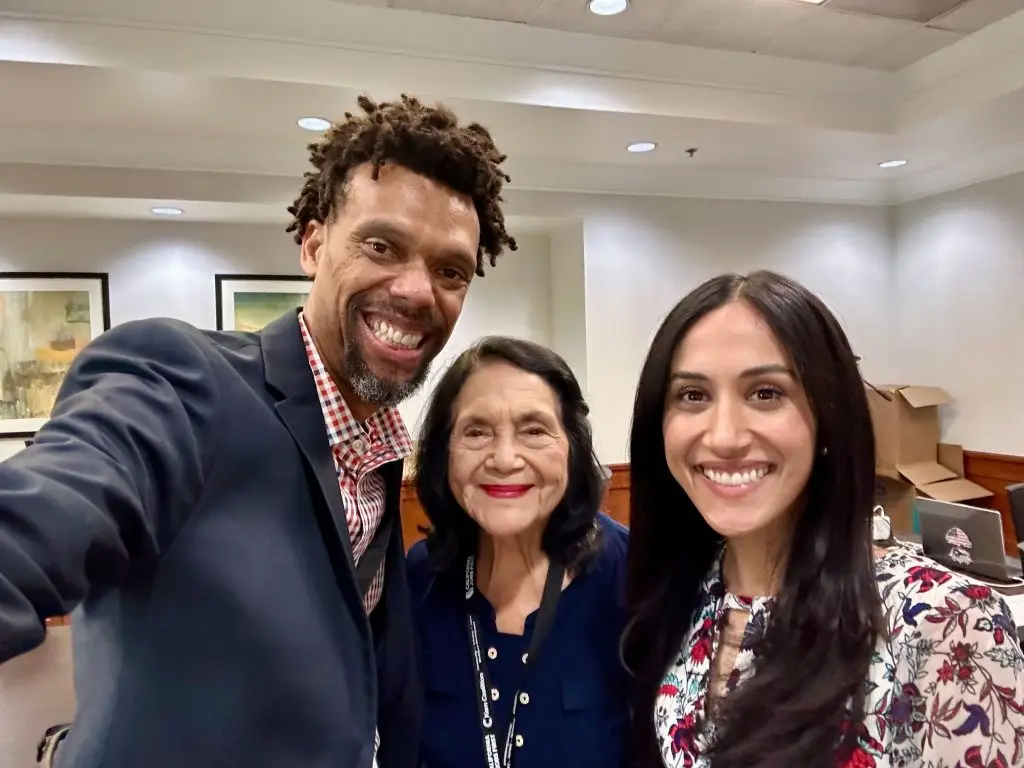
By Cecil Egbele | Contributing Writer | California Local News Fellow
The California Racial Equity Commission chair recalls his friendship with the civil rights icon, her solidarity with Bakersfield’s Black community, and the lessons she leaves behind.
To many Americans, Dolores Huerta was the fearless labor organizer who helped lead the farmworker movement and spent decades challenging institutions and demanding equal rights.
To Traco Matthews, she was also a friend who loved music, enjoyed dancing, had a wicked sense of humor, and never hesitated to pull people out of their comfort zones.
Matthews, chair of the California Racial Equity Commission and chief health equity officer at Kern Health Systems, met Huerta more than a decade ago. Their friendship deepened after the murder of George Floyd in 2020, when Matthews and other local Black leaders organized efforts to bring attention to racial justice and policing in Bakersfield.
He remembers Huerta not simply as a prominent Latino labor leader, but as someone who always showed up for the struggles of other communities, including Black residents.
As Huerta’s memorial ceremonies brought people together to celebrate her life and legacy, Matthews spoke with The Bakersfield News Observer about their friendship, her connection with the Black community, and the woman behind the public image.
Egbele: Beyond her reputation as a civil rights icon, who was Dolores Huerta to you?
Matthews: She was a friend. I was blessed to connect with her probably 10 to 12 years ago, and we really became close after George Floyd. Part of that was her commitment to making sure Black lives were valued and protected at the same level as everyone else’s.
I got to know her children; some of them attended my church for my installation as a pastor, and we stayed close. She was special to me.
Egbele: What is one memory that captures the person you knew?
Matthews: At her 95th birthday party, just over a year ago, she asked me to sing. Her youngest daughter, Camila, said, “We’ve heard you sing.”
They wanted me to sing Sam Cooke’s “A Change Is Gonna Come.” I was terrified. I’m a decent singer, but my wife is the singer, not me. But Dolores was always drawing me out of my comfort zone. And for her birthday, there was no way I could say no.
Another memory was watching her dance. She loved music and would go to concerts with her family. At one event, music started playing and here was this woman, probably in her mid-80s, out on the dance floor, getting everybody else to join her.
Then she called me out. I don’t dance. I grew up not dancing. But she said, essentially, if I’m dancing, you’re dancing.
I got on the floor, and at some point we danced together. I remember thinking, this is the wildest thing; I am literally dancing with our generation’s MLK.
Egbele: People often associate Huerta’s activism with farmworkers. What did you witness of her relationship with Bakersfield’s Black community?
Matthews: Our friendship really deepened after George Floyd.
I was one of the local Black leaders working with others to organize an event where we could bring our voices to law enforcement and say we needed changes locally. I remember arriving at St. Peter’s Restoration Church around 4:30 p.m. for a meeting ahead of an event scheduled for 6. There was a little lady already sitting in the front row. It was Dolores. She was already there, ready to participate.
She was always the first to a fight. She had the moral clarity and courage to say, “I know what’s right, and I’m going to lead by being the first to be there.”
After that, whenever we had community meetings or gatherings with elected officials, she was there. She wanted her voice heard as an advocate for the Black community, just like she was for others.
Egbele: Did you see her advocacy up close?
Matthews: Yes. I remember a 2022 effort around redrawing Bakersfield’s city council ward boundaries because the existing maps were not equitable and did not align with the Voting Rights Act. I attended a City Council meeting, and Dolores was there, sitting in the front row. When people were invited to speak, she was among the first.
She spoke about maps her organization had developed that aligned with the Voting Rights Act. Soft-spoken, she told the council, in effect, “You can vote for these illegal maps, but we’ll sue you and we’ll win.” The council voted unanimously for the legal maps her organization developed.
When Congress was considering H.R. 1, which cut Medicaid, Camila called me and said: “Mom and I are going to Congressman David Valadao’s office. She’s going to try to get arrested. Mom’s already been arrested seven times. She wants number eight.” She was almost 95.
That was Dolores. Every issue related to civil rights, inclusion, and people’s rights seemed to matter to her.
Egbele: What do you think enabled her to connect so naturally with the Black community and other groups?
Matthews: I think it went beyond personal relationships. She marched with people like Martin Luther King Jr. and John Lewis when opportunities presented themselves. She knew leaders in the civil rights, women’s rights, and LGBTQ+ movements. She loved the people she advocated alongside.
At the 2022 California Economic Summit, she did something I’ll never forget. She told a room full of people from different backgrounds and political persuasions that all of us came from Africa, so we’re all cousins. Then she asked everyone to stand, hold hands, look at the person next to them, and say, “Hi, cousin.”
And everybody did it. That’s Dolores. She could bring people together in a way that was both funny and profound.
Egbele: What should today’s community leaders learn from her?
Matthews: Two things.
First, the value she saw in every human being, and she was going to fight for those rights for every single human she saw, having the sacred value of being made in the image of God.
Second, she was always about policy. She’d say, I don’t care what you tell me; I want to see what you put in policy. You can’t stop fighting until it’s on paper, until change is written down and established. And even then, you have to hold people accountable because there are laws on paper that we are still not living.
For young people, I would refer to her signature statement, “Sí, se puede,” meaning “Yes, we can.” She faced enormous battles, but she believed the power of the people was much greater than the money and resources lined up against them. Her message was that no matter how difficult the battle, we can win; we will find a way, and we will keep fighting until we do.
Egbele: If she could speak to Bakersfield’s Black community today, what do you think she would say?
Matthews: I think she would borrow the words of the Black national anthem: “Let us march on till victory is won.”
She would speak about resilience, about the determination required to win battles that sometimes seem impossible. She never gave up. She traveled and advocated until she couldn’t travel anymore. Her daughter told me she was going to die with her boots on. She literally traveled until she couldn’t anymore.
Egbele: What is something about Huerta that people may not fully appreciate?
Matthews: How funny she was. She was hilarious. People knew her as this iconic civil rights leader who spoke truth to power, but she also loved the arts, music, and dancing. She could stand for hours, shaking hands and connecting with people.
She was not a politician, but she was the best politician in the room. She had such a deep appreciation for humanity and for what we could become as a people.
I was honored to know her and even more deeply honored to call her a friend. I love that lady.
