
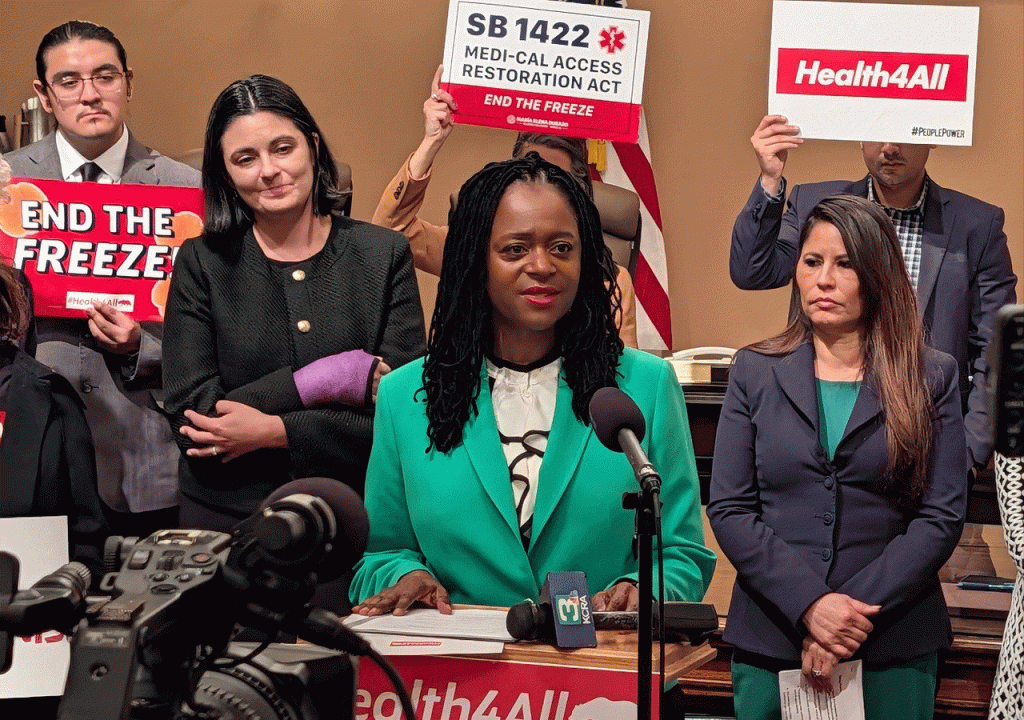
By Antonio Ray Harvey | California Black Media
A California rule requiring an unrelated adult man living with a family receiving welfare benefits to contribute financially to the household could be repealed if Gov. Gavin Newsom signs Senate Bill (SB) 1030 into law.
Authored by Sen. Lola Smallwood-Cuevas (D-Los Angeles), SB 1030 would eliminate the California Work Opportunity and Responsibility to Kids (CalWORKs) “Unrelated Adult Male,” or UAM, rule. Smallwood-Cuevas called the policy “outdated and actively harmful,” saying it relies on mid-20th-century gender stereotypes and subjects families to intrusive surveillance.
The Assembly approved the bill 77-0 on Aug. 19, followed by a 40-0 Senate concurrence vote five days later. Newsom has until Sept. 30 to sign or veto the measure.
“This is a law that helped divide our families. This is a rule that separated us from our mothers, fathers, and restricted men’s access to their families mainly because of the discriminatory practices of public housing systems back in the 1960s and 1970s,” said Smallwood-Cuevas, a member of the California Legislative Black Caucus (CLBC).
Under Section 11351.5 of the California Welfare and Institutions Code, an unrelated adult man living with a family applying for or receiving CalWORKs must make a financial contribution based on his income and expenses. He and the mother must disclose their household expense-sharing arrangement under penalty of perjury. Benefits may be discontinued if either person knowingly refuses to cooperate.
SB 1030 would repeal those requirements beginning July 1, 2027, or later if the state’s welfare computer system is not ready to implement the change.
Smallwood-Cuevas, a veteran journalist who has written about families relying on public assistance, said the law should be modernized as low-income households confront rising housing and food costs and broader economic uncertainty.
“We wanted to take that law off the books that limited men from being in the home with their families. We recognize Donald Trump is in the White House, and he will use all of the racist tools of the past to discriminate and surveil,” Smallwood-Cuevas told California Black Media (CBM).
Smallwood-Cuevas also told the Assembly Human Services Committee that SB 1030 was a priority of the California Legislative Women’s Caucus.
“Historically, the man in the house rule was disproportionately applied to Black women, women of color, reflecting a broader racialized system of surveillance and negative stereotypes and narratives. We know that was embedded in some of our early welfare policies,” Smallwood-Cuevas said.
“California must act to modernize this provision. Our families are already carrying the weight of rising rent, grocery costs, economic uncertainty, and the last thing California should do is make it harder for mothers to put food on the table and a roof over their families’ heads,” she added.
“Man-in-the-house” policies emerged from state welfare programs during the early and mid-20th century. They were later applied under Aid to Families with Dependent Children (AFDC), a federal assistance program established by the Social Security Act of 1935.
For decades, some state welfare agencies denied assistance to low-income families if an able-bodied man lived in or regularly visited the home, treating him as a substitute father regardless of whether he was legally or financially responsible for the children.
The U.S. Supreme Court addressed the practice in King v. Smith (1968). Alabama terminated AFDC benefits for a mother and her four children because a man who was not the children’s father visited her on weekends. In 1968, the court unanimously ruled that Alabama could not treat him as a parent because he had no legal duty to support the children.
California later enacted Section 11351.5, replacing the outright denial of benefits with a cost-sharing requirement for unrelated adult men living in CalWORKs households.
Smallwood-Cuevas compared the rule’s effect on Black families to the welfare policies depicted in the 1974 film “Claudine”, starring Diahann Carroll and James Earl Jones.
“Remember the film Claudine that was about the way Black families, male and female relationships that could not be cultivated because of this law,” Smallwood-Cuevas said. “We understand in this environment with unemployment rates, shutting down of industries that employ, particularly men in our communities, that sometimes men can’t contribute financially, but that doesn’t mean they don’t contribute to our families. These laws shouldn’t divide and separate our families, and this is what this rule has done for so many years.”
Rebecca Gonzales, senior policy advocate at the Western Center on Law and Poverty, told the Assembly Human Services Committee that such policies were used “to police the households of particularly Black women.”
The Western Center is co-sponsored SB 1030 as part of the Reimagine CalWORKs Coalition, which advocates for making the program more supportive of families and less punitive.
“The man of the house law is an outdated, misogynistic policy that incorporates racist and sexist assumptions about people who receive CalWORKs,” Gonzales said. “This provision, which is not required by federal law, presumed cohabiting men were substitute parents, regardless of financial contribution, and this was deemed unconstitutional in King v. Smith and further restricted by Lewis v. Martin (1970).”
“It also stemmed from outdated social mores, which disapproved of a couple who cohabitated without being married,” Gonzales added. “We believe it is extremely important that California repeals outdated, unneeded laws that are based on racist and sexist presumptions of human behavior.”