
By Earl Heath | Contributing Sports Writer
A Super Bowl halftime show months in the making unfolded largely in Spanish—bold, unapologetic, and pulsing with Latin rhythm. Leave it to Bad Bunny to command one of the world’s biggest stages while having millions bobbing, weaving, and smiling to a beat rooted in culture and community.
The moment felt foretold. Back in October 2025, during his opening monologue for the Season 51 premiere of Saturday Night Live, the native Puerto Rican—born Benito Antonio Martínez Ocasio—issued a playful challenge: “If you didn’t understand what I just said, you have four months to learn Spanish.” On Super Bowl Sunday, he delivered on that promise.
A Message Without Saying the Words
In the weeks leading up to the game, speculation swirled that Bad Bunny would use the halftime spotlight to make a political statement. While he didn’t explicitly repeat the “ICE out” phrase he voiced during his recent Grammy acceptance, the message was unmistakable—embedded in imagery, staging, and song choice rather than slogans.
More than 130 million viewers witnessed a performance dense with symbolism: utility poles, a child sleeping across chairs, and a modest pink-and-yellow house—details that spoke volumes to those familiar with Puerto Rican life. “I grew up in Puerto Rico, and to my family and me, these references were immediate and obvious,” one viewer reflected. “But without that lived experience, it was easy to miss how intentional those cues were.”
Home, Reimagined on a Global Stage
That sense of “home” expanded as Latino celebrities danced inside and around the small house onstage, a visual echo of island neighborhoods. Among those spotted were Pedro Pascal, Cardi B, Karol G, and Young Miko. Their presence underscored a broader message: the Americas are interconnected, and belonging transcends borders.
“El Apagón” and the Weight of Reality
One of the night’s most powerful moments came during “El Apagón,” which translates to “The Blackout.” As the song played, Bad Bunny and dancers dressed as line workers climbed electric poles. Transformers sparked and exploded—an all-too-familiar sound for many Puerto Ricans who live with fragile infrastructure, frequent outages, and the lingering effects of severe weather. The scene was art as testimony.
Love in the Middle of the Noise
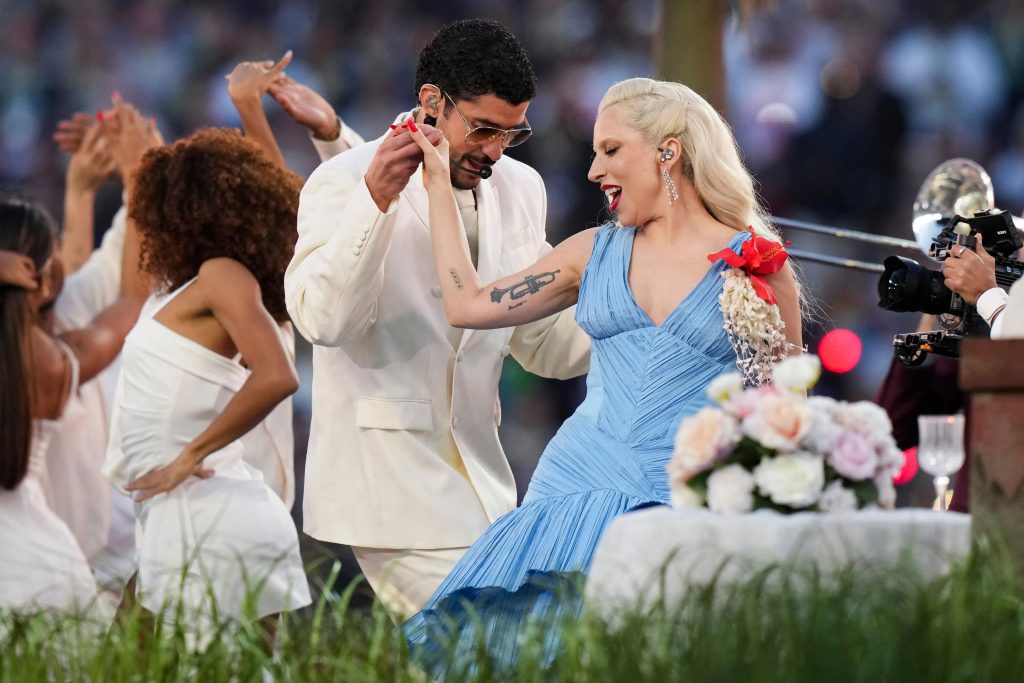
Amid the spectacle, the show carved out an intimate surprise. Covina natives Elisa “Ellie” Aparico and Tommy Walker were married live during the broadcast, serenaded by Lady Gaga, who performed “Die With a Smile.” “An incredible dance with the love of my life,” Walker later posted on Instagram—a reminder that even at the Super Bowl, joy can be personal.
From the Stage to the Streets

The halftime show’s ripple effects reached Los Angeles neighborhoods, too. Victor Villa of Villas Tacos in Highland Park saw his business make a Super Bowl debut, sparking lines around the block and a surge of community pride on Super Sunday.
A Closing That Said It All
As the final notes faded, Bad Bunny walked offstage at Levi’s Stadium holding a football, followed by dancers carrying flags from across North and South America. On the jumbotron appeared a simple declaration: “The only thing more powerful than hate is love”—the same words he spoke while accepting his Grammy for Best Música Urbana Album for DeBÍ TiRAR MáS FOToS. For a brief second, the football revealed another message: “Together, we are America.”
It was a halftime show that didn’t just entertain—it invited millions to listen, learn, and see themselves reflected in a broader, more inclusive vision of the nation.