
By Antonio Ray Harvey | California Black Media
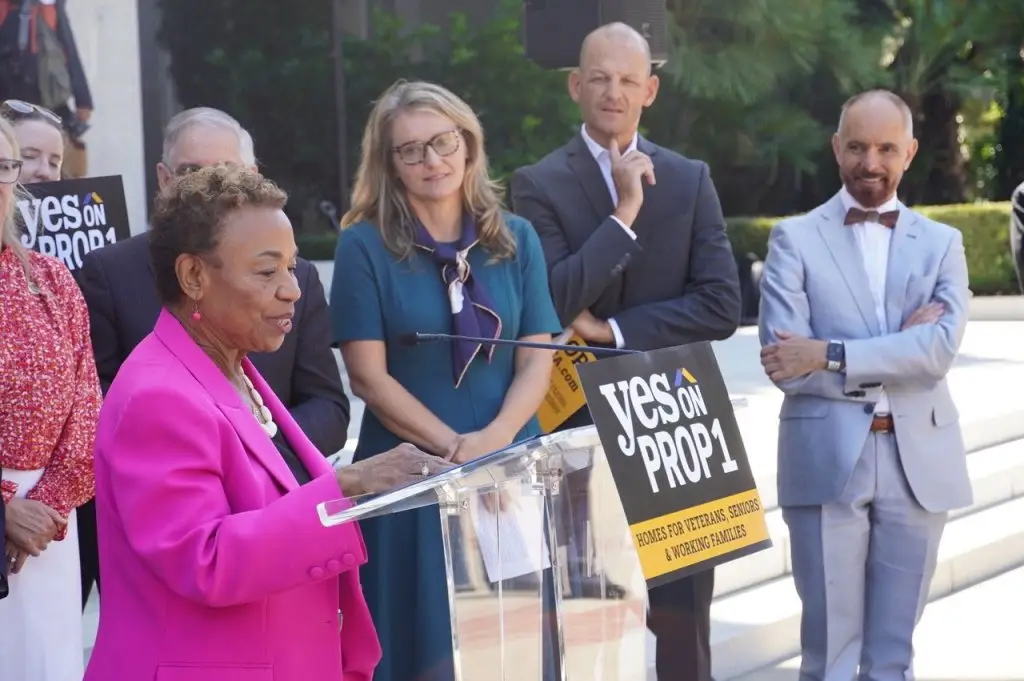
On Aug. 19, a bipartisan coalition of mayors from California’s largest cities gathered at the State Capitol to urge voters to approve Proposition (Prop) 1, an $11.25 billion housing and veterans bond measure on the November ballot.
Also known as the Veterans and Affordable Housing Bond Act of 2026, Prop 1 would provide state funding for local affordable housing projects.
Sacramento Mayor Kevin McCarty said cities need the measure’s support to address California’s housing crisis.
“Without help from the state and this ballot measure, we can’t do our jobs in cities across California. We need this measure to do our jobs,” said McCarty, a former member of the California Legislative Black Caucus (CLBC).
“We need Prop 1 for the future of California, addressing the issues of this generation, and housing affordability for all levels of income throughout California,” McCarty added.
The mayors said their jurisdictions lack the substantial subsidies needed to move shovel-ready affordable housing projects forward and help address the state’s homelessness crisis.

The coalition included Long Beach Mayor Rex Richardson, Oakland Mayor Barbara Lee, San Diego Mayor Todd Gloria, Fresno Mayor Jerry Dyer and San Francisco Mayor Daniel Lurie.
The city leaders were joined by Sens. Bob Archuleta (D-Pico Rivera) and Christopher Cabaldon (D-West Sacramento), as well as Assemblymember Buffy Wicks (D-Oakland). Supporters say the measure would help finance the construction of 40,000 affordable housing units statewide.
“In Fresno, more than 1 of 5 residents live in poverty. That’s nearly twice the state average,” Dyer said. “We need more affordable housing at every income level to include single-and multi-family dwelling units.”
Prop 1 would authorize $11.25 billion in general obligation bonds. Of that amount, $10 billion would support affordable housing and homeownership programs and be repaid from the state’s General Fund.
The measure would allocate $7.2 billion to build, acquire or rehabilitate rental housing through low-interest loans. Another $1.1 billion would support homeownership loan programs for low-and moderate-income households.
Prop 1 would also provide $500 million for housing infrastructure projects; $450 million for farmworker housing grants and loans; $350 million for student housing at University of California and California State University campuses; $200 million in housing grants for Native American tribes; and $200 million for local government pilot programs aimed at lowering housing costs.
An additional $1.25 billion would go to the CalVet Home Loan Program to help military veterans purchase homes. Those bonds would be repaid over time through veterans’ monthly mortgage payments, with the General Fund serving as a backstop.
Lee said the measure would provide critical statewide funding to complete much-needed affordable housing and permanent housing for people experiencing homelessness, building on a housing bond voters approved in 2018.
That measure, also called Prop 1, authorized California to issue $4 billion in general obligation bonds to finance housing programs. Lee said the 2026 measure would replenish funding for programs supported by the earlier bond.
“California’s last housing bond approved by voters in 2018 was fully committed years ahead of schedule,” Lee said. “Across the state right now, tens of thousands of affordable homes are sitting in the pipeline waiting on the last increment of funding to break ground. Prop 1 will replenish that funding. Without it, the pipeline stalls.”
Wicks and other supporters said the Legislature has enacted regulatory and permitting reforms to streamline housing approvals, leaving thousands of projects ready to begin construction once financing is secured.
“More than 40,000 affordable housing units are shovel-ready,” Wicks said, meaning they have cleared permitting and other regulatory requirements but cannot proceed without additional financing.
“I started working on this bond measure four years ago. It’s been four years of pushing the boulder up the hill to say, ‘This is our top priority for our working-class families in this state,’” Wicks said. “When we talk about (funding) resources, we talk about 40,000 shovel-ready projects ready to be built today if the bond passes.”
However, several Republican lawmakers opposed SB 417, the legislation that placed Prop 1 on the ballot.
Assemblymembers Philip Chen (R-Yorba Linda), Carl DeMaio (R-San Diego), Stan Ellis (R-Bakersfield), Heather Hadwick (R-Alturas), Alexandra Macedo (R-Tulare), Kate Sanchez (R-Rancho Santa Margarita) and David Tangipa (R-Clovis) voted against the measure.
In the Senate, Sens. Kelly Seyarto (R-Murrieta) and Tony Strickland (R-Huntington Beach) voted against SB 417. The Legislature approved the urgency measure on June 25, and Gov. Gavin Newsom signed it the same day.
Supporters argue that Prop 1 would not only expand affordable housing but also help address longstanding racial disparities in homeownership.
“Proposition 1 isn’t only about affordable housing. It helps working families to become homeowners, and that matters for equity,” Lee said. “Black and Latino homeownership has never recovered from decades of redlining and discriminatory lending. So, if we’re serious about closing the gap, homeownership must be part of that answer.”