
By Marion Apio | Contributing Writer | California Local News Fellow
Officials are urging thousands of unhoused Angelenos to seek refuge in cooling centers and to take advantage of other outreach services amid an extreme heat warning issued by the National Weather Service.
For unhoused Angeleno Tef Ejigu, 47, following such suggestions remains an ongoing challenge.
“It’s been very difficult,” Ejigu said. “I try to make sure I hydrate a lot and stay out of direct sun as much as I can. But you know, there’s certain times of the day you can’t be inside a tent.”
The National Weather Service forecasts highs of 90s downtown and soaring past 100 degrees across inland valleys, triggering the extreme heat warning.
Local officials urge residents to take cover indoors, keep air conditioning units set between 75 and 80 degrees and seek refuge in public cooling centers.
The heat wave presents an immediate survival challenge for thousands of unsheltered Angelenos, a number that continues to rise.
According to city and county data, unsheltered homelessness in Los Angeles rose 7.9% this year to an estimated 29,115 people, while countywide unsheltered numbers climbed 3.3% to 49,002.
Adults comprise 64.3% of the unhoused population. Youth represents 2.7%.
On the street, environmental conditions remain perilous.
Places where the unhoused tend to congregate have under 3.5% tree canopy coverage, creating an urban heat island where dark asphalt and concrete trap heat during the day and radiate high temperatures well into the night.
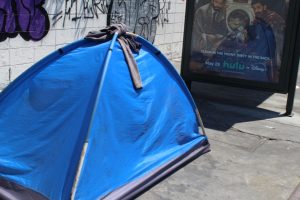
Standard nylon tents and plastic tarps act as ovens, driving internal temperatures 10 to 15 degrees higher than the surrounding air and elevating the risk of heatstroke for anyone inside.
To cope, Ejigu makes seemingly minor, but critical, decisions throughout the day to keep cool while on Skid Row in downtown Los Angeles.
“I’ll choose a spot in the shade, you know,” he said. “If I walk on one side of the street, I try to walk on the shady side of the street and just take care of myself that way.”
While municipal cooling centers can be difficult to reach without abandoning personal belongings, Ejigu noted that access to drinking water downtown has been manageable thanks to community resources.
“They have watering stations where you can go up and get a cup of water,” Ejigu said. “They have bottles of water at their different resource centers. There’s plenty of water, thank God.”
Still, the relentless temperature takes a psychological and physical toll.
“I don’t like it. It makes me a little irritable. Makes me uncomfortable,” Ejigu shared, gesturing toward a sun-exposed pavement block. “I’d rather be doing this interview in the shade, but I ended up in the sun.”
Grassroots mutual aid groups like Water Drop LA, SELAH, and Ktown for All continue delivering ice, bottled water, and electrolyte packages directly to sidewalk encampments, supplementing local watering stations.
While county emergency management officials stress that heat-related illnesses are entirely preventable through public cooling centers and indoor air conditioning, homeless advocates and outreach providers point out that emergency advisories often fail to account for the mobility and property barriers faced by unsheltered residents.
In a public health advisory, the Los Angeles County Department of Public Health noted that unhoused Angelenos remain among those at “significantly higher risk of severe heat illness,” prompting the county and partner agencies to deploy mobile outreach teams with emergency hydration supplies during extreme weather activations.
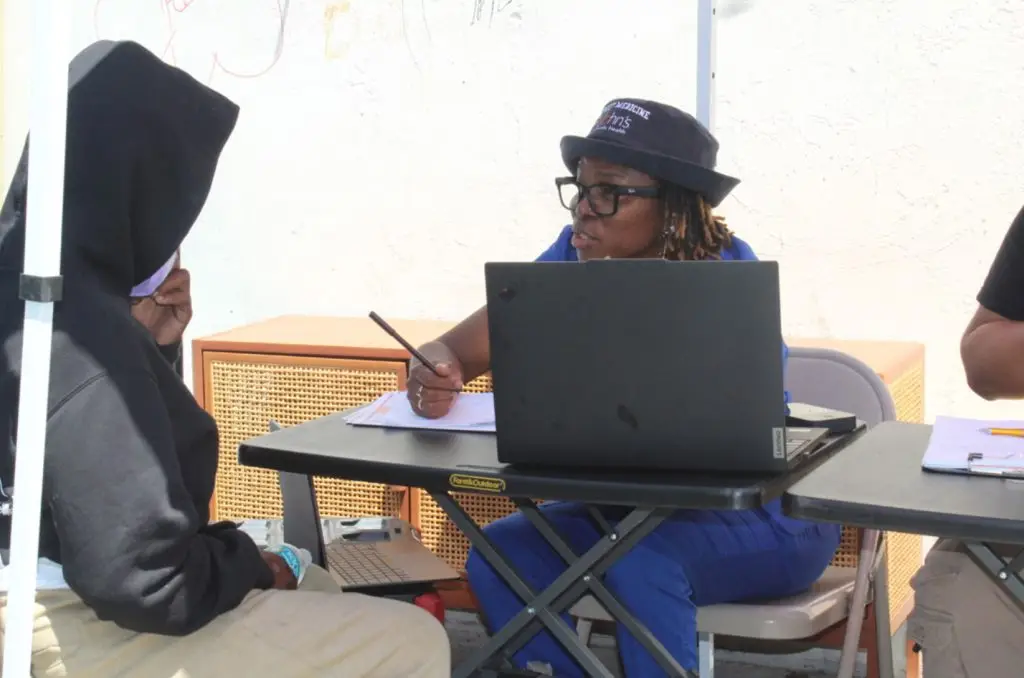
Frontline healthcare workers are also working to fill the vital gap in care.
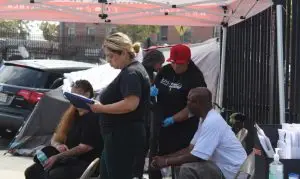
Dr. Bukola Olusanya, a clinician and street medicine team leader with St. John’s Community Health, noted that L.A.’s extreme weather swings create distinct physical challenges for patients on the street.
While mornings and nights offer brief cool periods, temperatures surge sharply in the afternoon.
“What we’re doing is we ice the water—so solid iced bottles, that’s what we give to them, plus the ones at room temperature,” said Olusanya, whose mobile team distributes multiple bottles at a time alongside Vitamin C to support hydration. “The moment we see them, we give them that ice water so that they can cool off.”
Yet mobile outreach teams face inherent structural limits, typically visiting specific encampments once or twice a week.
“When we’re not there, I wonder how they survive that kind of weather, being on the street, being on the sidewalk, when we’re not there,” Olusanya said. “That’s the gap that we have.”
Healthcare providers emphasize that extreme heat outdoors presents complex medical risks beyond simple dehydration.
Many unsheltered individuals take prescription medications for mental health or blood pressure that impair the body’s natural thermal regulation and suppress sweating. Also, critical warning signs of heatstroke—including confusion, slurred speech, and delirium—are frequently misidentified by passersby or law enforcement as substance intoxication, delaying life-saving emergency medical responses.
While mobile clinics provide iced water, oral rehydration, and basic care, severe cases must be escalated immediately.
“If we see a patient who is extremely dehydrated, we do what we have to do and send them to the ER where they can get an IV infusion or something that can make sure that they are safe,” Olusanya said. “We will make sure that they get to the right place.”
For immediate heat safety resources, cooling center locations, or non-emergency assistance, Los Angeles County residents can visit ready.lacounty.gov/heat or dial 2-1-1. In cases of severe heat distress, unresponsiveness, or medical emergencies, dial 9-1-1.