
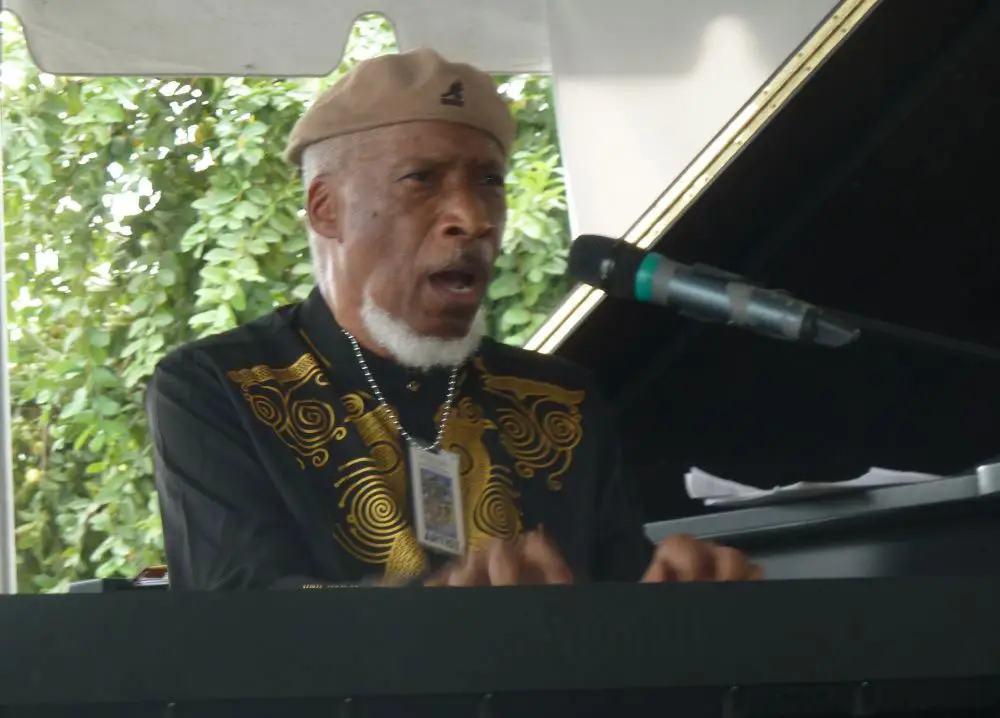
By Ricky Richardson | Contributing Writer
Los Angeles, CA – The City of Los Angeles Department of Cultural Affairs (DCA) and Friends of Watts Towers Arts Center presented a wonderful two-day showcase of music, rhythms, culture, art, cuisine, and community with the 44th Annual Watts Towers Day of the Drum Festival on Saturday, September 26, and the 49th Annual Simon Rodia Watts Towers Jazz Festival on Sunday, September 27, 2026. Both festivals ran from 10:00 am-6:00 pm at the Watts Towers Arts Center Campus, one of Los Angeles’s iconic, historic landmarks. (1727 East 107th Street, Los Angeles, CA. 90002). Where Truth, Art & Community Connect!
James Janisse and Kamau Daáood returned again to serve as co-host emcees for both days of the festival. The festival poster and program were designed by esteemed artist Ramsess. Ramsess is a Leimert Park-based community artist dedicated to creating accessible art for the public. A self-taught multidisciplinary artist, Ramsess works in textiles, stained glass, mosaic, illustration, clay sculpture, and portrait quilting. Deeply inspired by blues and jazz, much of his work honors celebrated musicians and their cultural legacies.
On Saturday, the Watts Towers Day of the Drum Festival celebrated percussion traditions from across the globe. The global rhythms of drums reverberated throughout the Watts Towers Arts Center Campus. Many of the drums played during the drum festival have several things in common. Many are over a hundred years old, play a huge role in their respective cultures, and remain relevant across different genres of music.
Danza Azteca Xochipilli was amazing as they performed traditional music, shared cultural stories, and the dance of the Mighty Aztecs. They opened their set with a traditional Aztec Ceremony and dance dedicated to the Azteca Chichimec People. They concluded their interactive performance with a Friendship Dance, to the delight of participants. Danza Azteca Xochipilli performed on the Huehuetl and Teponaztli drums, whistles, and shakers.
The beauty of the Watts Towers Day of the Drum Festival is that we all had the opportunity to travel to various countries to be engaged in the culture of each respective country.
The large, diverse, multicultural crowd and I braced ourselves for the day-long cultural journey through dance, drums, and singing.
The Taiko Project is a popular group based in Little Tokyo. They explained and performed on various Taiko drums that have roots in Korea and China. It was exciting to view their thunderous performance featuring synchronized, choreographed movement, and improvisation on drums. The highlight selection that they performed was “Expanding,” consisting of a definitive hip-hop beat. This track had the crowd grooving along to the beat. They followed with “Here We Go Now.”
Leimert Park-based S.H.I.N.E Muwasi; led by Rene “Mama Ne Ne” Fisher, led the crowd in an empowering program of West African drumming, dancing, and singing. They thrilled the crowd with “Lamba/Danza,” “Tiribia,” “Sunu,” and “Kuku.” S.H.I.N.E. Muwasi performed on the Djembe and dundun drums.
Katie Hernandez & Kimbambula Dance and Music Ensemble showcased a dazzling display of Afro-Cuban music and dance. They opened their set with several Orisha selections, followed by an Afro-Cuban Franco-Haitian track, rumba, and concluded with a festive Comparsa. The dancers exuded contagious exuberance and joy throughout their performance! Kimbambula Dance and Music Ensemble used congas and bata drums during their performance.
Gan Gan Akojopo featuring Rasaki Aladdin, Tunde Akangbe, Munyungo Jackson and David Leach was the real deal, as we travelled back to the Motherland. The first two musicians used traditional talking drums that go back thousands of years. The talking drum, aka, dùndún is an hourglass-shaped drum from West Africa and is used in long-distance communication and signaling. Munyungo Jackson performed on the congas, shékere, and agogo bell. David Leach rounded out the band on Shékere. Each of the above-mentioned instruments was featured prominently throughout their mesmerizing set.
The next group, Drum Talk, featured a rhythmic conversation between world-renowned touring musicians. There was a lot of improvisation and fireworks on display.
Our global journey for the afternoon landed in Brazil. Bloco Obini is an all-Queens Afro-Brazilian drum ensemble founded by Kahlil Cummings. They closed out the Watts Towers Day of the Drum Festival with a lively set of percussion and dance that honored the ancestral heritage across the diaspora. The group performed on the Brazilian Surdo, which is a Brazilian version of an American bass drum.
I returned to the Watts Towers Arts Center Campus with hundreds of music aficionados. On Sunday, September 27, 2026, the Simon Rodia Watts Towers Jazz Festival put the spotlight on the sounds of salsa, funk, gospel and hip-hop alongside classical and contemporary jazz traditions.
Alaadun, led by Baba Imodoye Shabazz, got the program underway with a Yoruba ground Blessing, invoking ancestors, community reflections, and healing. The group consisted of top-notch percussionists from Africa, America, Cuba and Puerto Rico.
Adaawe kept up the momentum and cranked it up a notch with beats from the diaspora. Their lively performance consisted of the selections “Wewe,” “Sikiya,” Yankadi/Makuru, “Waka,” and “Jingoloba,” by Santana. They concluded their set with “Amampondo” and “Djole.”
Todd Cochran Trio/TC3 band is made up of Todd Cochran on piano, John Leftwich on bass, and Lyndon Rochelle on drums. They performed a set of original and classic jazz selections. They opened with an original by Todd entitled “Behind the Mask,” followed by “Bemsha Swing” by Thelonious Monk, and “Afro Blue” honoring the musical legacy of John Coltrane. They continued with “Wade in the Water” by Ramsey Lewis, and concluded their set with “The River Bends.”
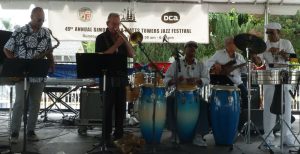
The Bobby Matos Tribute Band featured percussionist Robertito Melendez, trombonist Dan Weinstein, Theo Saunders on piano, Eddie Resto on bass, and Don Littleton on congas. They honored the life and musical legacy of the late great percussionist Bobby Matos with hits from his extended catalog of original music. They opened their set with hard driving, dancing rhythms with “Song for Judd,” written by Bobby Matos for his son. They continued with “Santa Barbara,” followed by “Mambo Chris,” composed by Theo Saunders, “Uncle David’s Egg Creams,” and concluded with “Da Me Tu Amor,” composed by Dan Weinstein.
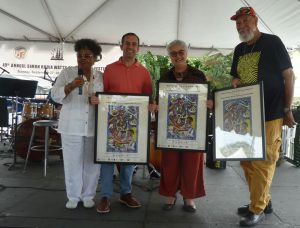
There was a pause for the cause… community members or organizations are honored each year during the Simon Rodia Watts Towers Jazz Festival for their support or contributions to the community. This year’s honorees were honored for their continued support of the drum and jazz festival. 2026 Honorees included Daniel Tarica, General Manager, City of Los Angeles Department of Cultural Affairs, Los Angeles Mayor Karen Bass, and Poet and Spoken word artist Kamau Daáood. Jacqueline Hamilton, Office of Mayor Karen Bass, Deputy Mayor of Neighborhood Services accepted the award on behalf of Mayor Karen Bass.
The festival continued with a brilliant and swinging set of jazz by Larry Nash & The Jazz Symphonic All-stars. They dedicated their set to the memory and spirit of Sonship Theus. Their set had the old-school jazz aficionados swaying and bopping to the selections “The Spell of Jasmine,” “”Athena,” “Mississippi Jump,” and ” It’s the Last Day of Summer,” featuring breakout vocal styling of Ashley Chanel. Larry used “Cold Duck Time” to introduce his tight band: Ricky Woodard-sax, Yvette Deveraux-violin, Richard Simon-bass, Paul Kreibich-drums, David Leach and Munyungo Jackson on percussion, and Ashley Chanel on vocals.
The Caribbean All-Stars were superb as they showcased an exciting program of Caribbean music from Reggae, Soca, Calypso and pan steel drums.
Medusa Tha Gangsta Goddess, aka The Godmother of West Coast Hip Hop, concluded the festival as she added immensely to our enjoyment of the 49th Annual Simon Rodia Watts Towers Jazz Festival.
The City of Los Angeles Department of Cultural Affairs (DCA) empowers Los Angeles’s vibrant communities by supporting and providing access to quality visual, design, literary, musical, performing, and educational arts programming; managing vital cultural centers; preserving historic sites; creating public art; and funding services provided by arts organizations and individual artists.
Formed in 1925, DCA promotes arts and culture as a way to ignite a powerful dialogue, engage LA’s residents and visitors, and ensure LA’s varied cultures are recognized, acknowledged, and experienced. DCA’s mission is to strengthen the quality of life in Los Angeles by stimulating and supporting arts and cultural activities, ensuring public access to the arts for residents and visitors alike.
DCA advances the social and economic impact of arts and culture through grantmaking, public art, community arts, performing arts, and strategic marketing, development, design, and digital research. DCA creates and supports arts programming, maximizing relationships with other agencies, artists, and arts and cultural nonprofit organizations to provide excellent service in neighborhoods throughout Los Angeles. For more information, please follow us on all social media platforms.