
By Cecil Egbele | Contributing Writer | California Local News Fellow
Gigi Dagare’s son is autistic, has ADHD, and does not speak.
One night, while the family slept, the 19-old boy walked out of their home in Natomas, a Sacramento neighborhood. His mother said he was found about a 40-minute drive away.
“It’s too stressful for us,” Dagare said. “So if this program is cut, it’s going to be a disaster.”
She was referring to In-Home Supportive Services, or IHSS, a state program that pays caregivers, often family members, to help seniors and people with disabilities live safely at home. Most of the program funding comes through Medi-Cal, California’s version of Medicaid.
Dagare, an IHSS provider and executive board member of SEIU Local 2015, said she gave up her career to care for her son around the clock.
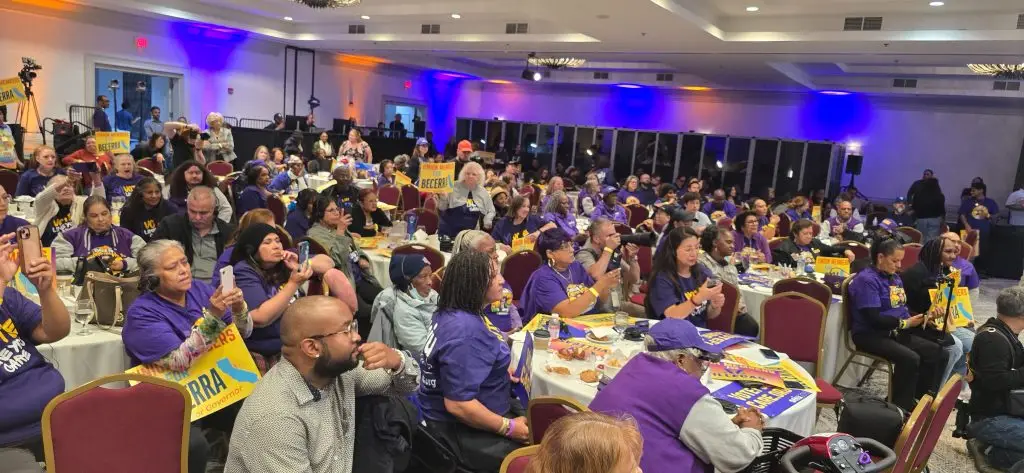
Dagare attended a union rally at the Bakersfield Marriott in support of Democrat Randy Villegas, who is running for Congress, and Xavier Becerra, who hopes to become the state’s next governor.
SEIU Local 2015 represents nearly 450,000 long-term care workers, making it the state’s largest union. Its members say federal Medicaid cuts in H.R. 1, the tax-and-spending law Republicans call the One Big Beautiful Bill Act, put both their paychecks and the people they care for at risk.
‘Our hours are being cut’
Leilani Reed, a home care provider and SEIU Local 2015 regional vice president, said she has already heard from workers whose hours were reduced without explanation.
“Right now some people’s hours are being cut and they don’t know why. With those hours being cut, that means that’s less money,” Reed said. “They are already making less money.”
Many cannot simply take a second job, she said, because the person they care for cannot be left alone. She is concerned about a relative of hers whose disabled son’s medicine and therapy are no longer covered.
Reed argued that changes to care programs affect more than the workers who provide services. They can also affect people with disabilities, seniors and families who rely on assistance to remain safely at home.
“If the cuts continue,” she warned, “you’re going to see homelessness rise.”
Why the choice of candidates
SEIU Local 2015 President Arnulfo de la Cruz said the gathering reflected frustration with federal decisions the union believes threaten working families and access to health care.
He criticized Valadao for supporting federal legislation that, he argued, would reduce health care funding while providing tax benefits to wealthy individuals and corporations.
Valadao has said he supported H.R. 1 because it protected Medi-Cal for the most vulnerable, including children, pregnant women, people with disabilities, and seniors.
De la Cruz said the union supports Villegas because his background as the son of immigrants, the son of an auto shop owner, and an educator gives him an understanding of working-class concerns.
He described one member, whom he would not name, who is living in the United States on a temporary visa for people affected by global disasters or crises and who now fears being deported while also facing cuts to pay and health care.
At the rally, Becerra said he has cared for his own parents.
Villegas said restoring Medicaid and IHSS funding would be his top priority in Congress.
Holding them to account
De la Cruz urged members to visit lawmakers’ offices and share their stories.
“They say the squeaky wheel gets the grease,” he said. “The way that we hold people accountable is not with our fists. We do it with our ballots.”
He said the union’s work with candidates it backs doesn’t end on Election Day.
“The way that you hold them (elected officials) accountable is you stay in touch with them,” he told rally attendees. “You send union members and families and people with stories to their congressional offices in D.C. You meet with their people here in the district.”
De la Cruz, whose grandmother, Jessie De La Cruz, is said to be one of the first women leaders of the United Farm Workers, said he spent part of his childhood in Bakersfield and Delano during the farmworker movement and understands the fight for economic and civil rights.
Reed said the union plans to check in with winners after the election with something like a progress report.
“They will continue to see our faces,” she said. “This is going to be something totally different, not just for the optics.”
For Dagare, the stakes are personal. If the funding stops, she said, she would be forced to leave her son to look for a job so the family can survive.
“All the new elected candidates need to stand for us, with us,” she said, “in order to prevent any disaster for our children and our loved ones.”
