By Marion Apio
Inglewood Mayor James T. Butts Jr. defended the city’s commercial billboard program at a District 4 town hall meeting held Sept. 23, arguing that a ballot measure targeting advertising on public property could threaten millions of dollars in municipal revenue.
Measure BB, on the Nov. 3 ballot, would change the city’s authority to permit advertising on public rights-of-way and certain available properties. Butts urged residents to consider the financial implications of restricting the program, which he said generates revenue without requiring the city to raise taxes.
“We have the right as a people to have self-determination,” Butts said.
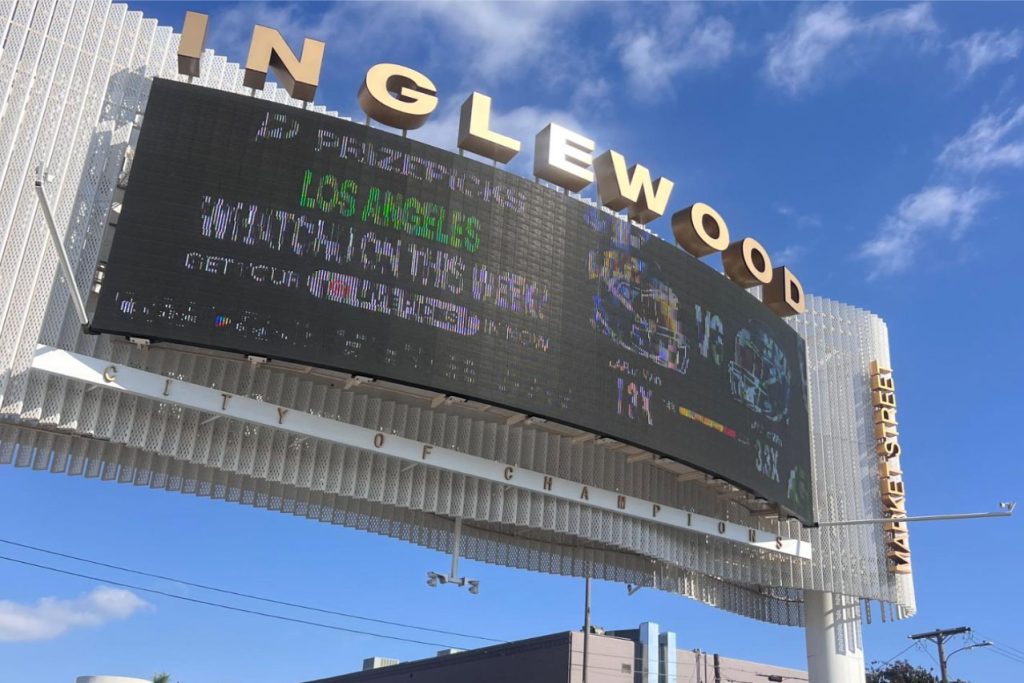
He told residents that the city entered into an agreement with a media company in 2014 to install large digital billboards on city-owned land. According to Butts, the company paid the construction costs, while the city received a share of the advertising revenue.
The mayor said the agreements gave the city a way to generate income from property it already owned, including during financially difficult years.
“Those big digital boards you see in Inglewood were built on city land, ” Butts said.
The city later negotiated a separate arrangement for traffic-information kiosks along Prairie Avenue, Century Boulevard and Manchester Boulevard. Butts said the kiosks display traffic information and commercial advertising, generating additional revenue.
“We make money while we sleep,” he said. “That’s what smart people do. They make — they have performing assets.”
Butts cited approximately $8 million in annual billboard revenue during the meeting. Published reporting on city budget records has placed the revenue at several million dollars annually, with amounts varying by fiscal year and calculation method.
The mayor said the money helps support senior mobility services, pre-kindergarten education and a $500 property-tax rebate previously provided to eligible homeowners. He also cited a program at the city’s senior center that he described as a “blue zone.”
“That $8 million a year … pays for a blue zone in our senior center,” Butts said.
City Treasurer Angela Allen also told residents that municipal revenue supports programs for seniors, including a utility-tax reimbursement program for residents age 62 and older.
The budget records reviewed for this report did not establish whether billboard receipts are specifically earmarked for those programs or whether the services are funded through the city’s broader General Fund.
Butts also discussed legal disputes involving the city’s billboard agreements. In 2025, venue-related companies challenged the city’s agreement with billboard operator WOW Media in Los Angeles Superior Court. The cases included Pincay Re, LLC, et al. v. City of Inglewood, et al., case No. 25STCP02561, and Forum Entertainment, LLC, et al. v. City of Inglewood, et al., case No. 25STCP02940.
Published reporting on a June 2026 ruling said the court rejected several challenges to the billboard agreement, including claims concerning the public right-of-way and competitive bidding. The ruling did not resolve every claim related to alleged breaches of development agreements. Subsequent appellate proceedings were not independently verified in the records reviewed.
Butts alleged that opponents of his administration backed Measure BB after losing legal challenges to the city’s advertising arrangements.
“When they lost the court case, they funded an initiative called Measure BB,” Butts said. “So they would decide for us that these billboards that bring us $8 million a year are bright.”
Butts also accused his political opponents of spending heavily to remove him from office, alleging that an independent expenditure account had been established with hundreds of thousands of dollars. His remarks did not establish the precise amount spent or identify all contributors.
The mayor urged residents to support Measure AT, a separate ballot measure that would change how the city collects admissions taxes from major entertainment venues. Under the existing arrangement, qualifying venues pay a 10% admissions tax subject to an annual revenue cap.
Measure AT would remove the cap for venues with at least 20,000 seats and introduce a 2.5% admissions tax for venues with at least 10,000 but fewer than 20,000 seats. NBC Los Angeles reported that a city impact report dated July 22, 2026, estimated the changes could generate an additional $47 million to $50 million annually. The projected revenue would go to the General Fund, although actual collections would depend on ticket sales, event activity and implementation of the measure.
Butts argued that removing the admissions-tax cap would give the city greater financial flexibility, while restricting billboard advertising could reduce another source of municipal revenue.
“This moment in our evolution as a city is going to define what we are for our young generation,” Butts said. “It’s going to define whether we wait for handouts or whether we build for ourselves.”
Inglewood voters will decide the fate of Measure BB and Measure AT on Nov. 3.