By Marion Apio | Contributing Writer | California Local News Fellow
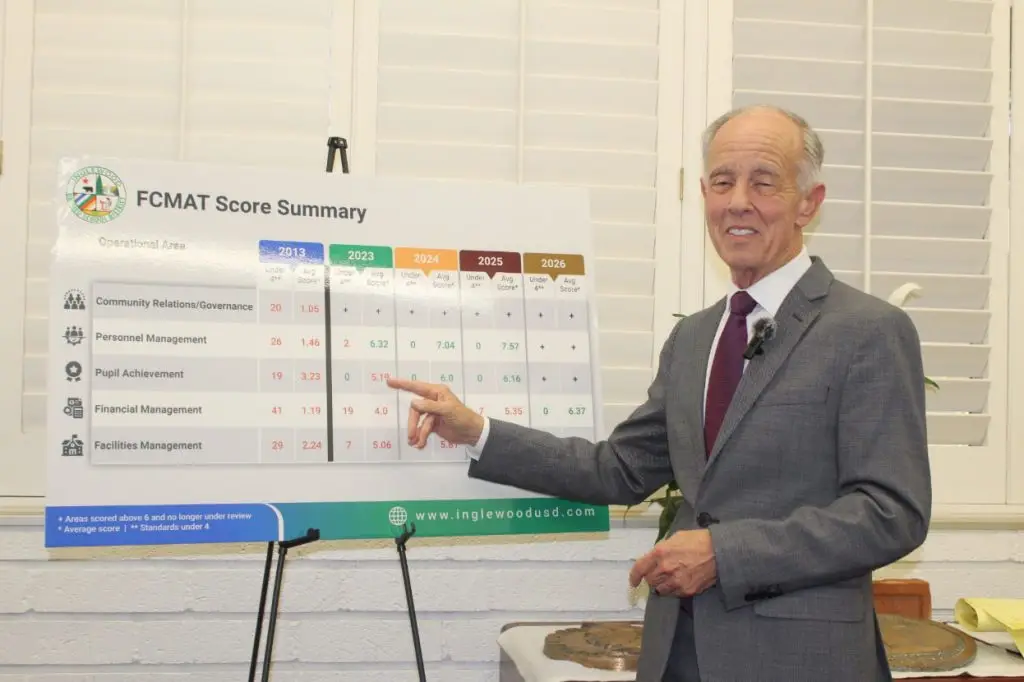
As the Inglewood Unified School District (IUSD) opened its doors for the 2026–27 school year on Monday, August 17, district leadership stood on the threshold of a historic turning point. Backed by all 153 standards met on its latest Financial Crisis and Management Assistance Team (FCMAT) review and a 95% first-day attendance rate, the district is within arm’s reach of returning to local governance after nearly 14 years under state receivership.

As County Administrator James Morris explained in an exclusive interview with the Los Angeles News Observer, exiting receivership requires maintaining these operational systems through a final FCMAT review in January 2027 before the elected Board of Education regains voting authority.
Beneath the optimism lie enduring hurdles, including steep historical enrollment declines from roughly 18,000 students in 2000 down to approximately 6,000 this school year, ongoing staffing vacancies in special education, and community anxieties regarding immigration enforcement.
Where IUSD Stands: 14 Years of Receivership Nears Its Final Review
Placed into state receivership in 2012 after tumbling into severe financial distress that necessitated a state emergency loan, IUSD lost its locally elected school board’s voting authority, with state-appointed administrators holding decision-making power. In the district’s latest FCMAT assessment, IUSD successfully met all 153 standards across financial management, facilities, personnel, pupil achievement, and community relations.
Morris explained that the FCMAT review team will return in January 2027 to verify that systems—such as monthly utility bill monitoring committees and periodic HVAC maintenance checklists—remain firmly entrenched. Upon successful review, the district will officially exit receivership.
“Absolutely nothing is going to derail that timeline. It is going to happen. Last year, when FCMAT did their review, they saw that we had systems in place to meet each of the standards. We just have to make sure we maintain those systems.” James Morris
Why the District Changed Dramatically: Enrollment and Facility Overhauls
Behind the district’s capital momentum lies a stark demographic shift, with enrollment dropping from roughly 18,000 students to around 6,000, forcing painful administrative decisions regarding school closures and consolidations, including the merging of Worthington School and Woodworth-Monroe, and the shuttering of specific middle and elementary sites.
“We can’t continue to operate all of these schools. Why? Because there’s costs associated, and every single one of our schools in Inglewood in 2023 had more than 50% capacity available.” James Morris
To win back family confidence, IUSD has instituted aggressive academic reforms, including phonics-based elementary reading curricula, modernized math programs, mandatory training institutes for teachers and principals, and formative assessments every six to eight weeks.
To measure academic progress alongside these curricular shifts, recent district assessments indicate incremental gains: elementary reading proficiency on formative benchmarks has risen by 4% over the past year, while middle school math scores show steady upward trends following the implementation of targeted intervention blocks. However, district officials acknowledge that overall proficiency rates remain below pre-receivership benchmarks, signaling that closing the achievement gap will require sustained multi-year effort.
Infrastructure has undergone an equally dramatic transformation. When Morris arrived in January 2023, he encountered severe deterioration, including a high school stair skid guard held on by duct tape and an emergency school closure caused by a ruptured gas main.

Utilizing voter-approved bonds from Measure I (roughly $230 million to $235 million), the historic 1924 Inglewood High School campus at Manchester Boulevard and Grevillea Avenue is currently 90% demolished and being completely rebuilt. Students currently share the Morningside campus under the banner “Inglewood High School United” until the new facility opens for the 2028–29 school year, featuring a planned pedestrian bridge connecting directly to the City of Inglewood’s $50 million refurbishment of the Inglewood Public Library.
Furthermore, IUSD is placing Measure MM on the November 3 ballot to fund ongoing district-wide modernization—costing taxpayers approximately $18.50 per $100,000 of assessed property value annually—while celebrating three consecutive bond rating upgrades that lower taxpayer borrowing costs. On the operational front, Morris noted that while recent 10% competitive salary increases have bolstered staff retention, vacancies remain persistent in specialized areas such as special education, where substitute teachers continue to fill critical classroom roles.

What Happens Next: Returning to Local Control and Rebuilding Trust
As the district counts down to the final FCMAT review in January 2027, Morris outlined the profound shift that local control will restore: the elected five-member Board of Education will regain its full voting authority and hire a permanent superintendent, ending years of appointed state oversight and returning ultimate decision-making power, policy oversight, and budget approval directly to the community’s elected representatives.
Addressing community anxieties surrounding shifting demographics and immigration enforcement, Morris highlighted a notable dip in the district’s newcomer student population (students in the country for three years or less), which dropped from roughly 400 annually down to 200 last year. To ease fears among mixed-status families, IUSD has implemented robust campus privacy protocols based on state model policies, backed by a direct message from leadership:
“We don’t collect any documentation about citizenship. We don’t collect any of that information. We don’t have access to that information. We don’t want that information. We want your children. We want them in school, and we want to give them the best education that we possibly can.” James Morris
Through dedicated web resources and partnerships with community organizations and the Inglewood Educational Foundation, IUSD also provides basic necessities such as clothing, shoes, and backpacks via community closets established across seven grant-funded community schools.
As IUSD stands on the threshold of its final FCMAT review in January 2027, the district’s return to local governance after nearly 14 years under receivership represents a historic milestone. Maintaining the rigorous operational systems that secured this progress will be the defining final step in restoring full voting authority to the elected Board of Education and returning ultimate decision-making power directly to the Inglewood community.