
Staff | California Black Media
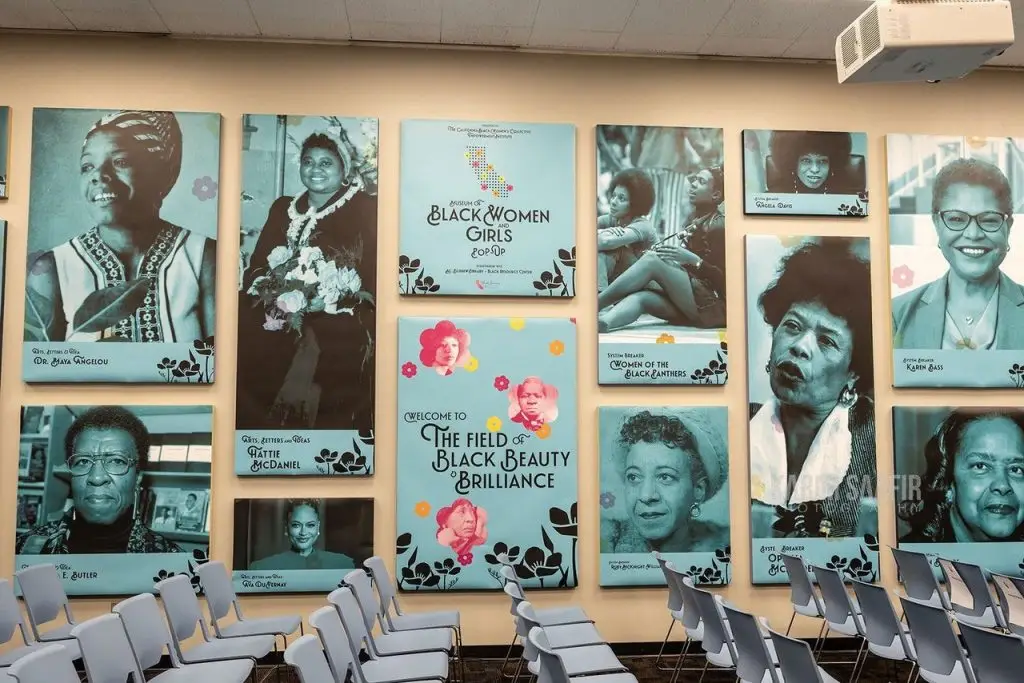
In Los Angeles, visitors attending a Juneteenth weekend event at the A.C. Bilbrew Library were welcomed by a museum exhibit featuring a wall of faces — filmmakers and freedom fighters, Olympians and lawmakers — honoring Black women’s achievement and leadership.
For many of the Black women in the room, the moment landed like a long-held breath finally released.
“The Museum of California Black Women is an invitation to see Black women in full,” said Kellie Todd Griffin, president and CEO of the California Black Women’s Collective Empowerment Institute, who curated the exhibition.
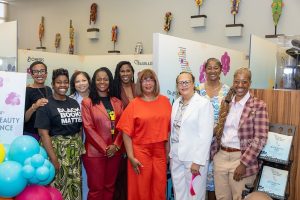
Titled “A Field of Beauty and Brilliance,” the cultural exhibition opened to the public June 22 and runs through Sept. 30 at the library’s Black Resource Center in Los Angeles. Admission is free. Presented in partnership with the Black Resource Center, it uses artifacts, immersive installations and interactive displays to trace the political, artistic, athletic and civic contributions of Black women across generations.
The featured names span California’s cultural landscape: filmmaker Ava DuVernay, Los Angeles Mayor Karen Bass, Oakland Mayor Barbara Lee, U.S. Rep. Maxine Waters (D-CA-43), authors Maya Angelou and Octavia Butler, scholar Angela Davis, and athletes Allyson Felix (track and field), Venus and Serena Williams (tennis) and Cheryl Miller (basketball).
The exhibition also marks the launch of Black California Love Stories, an oral history project collecting the family histories, traditions and milestones of Black Californians for preservation on the library’s website.
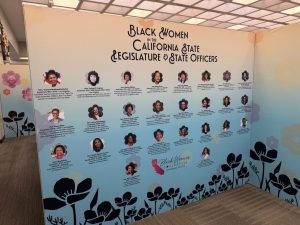
For the lawmakers who spoke, the wall was personal. State Sen. Lola Smallwood-Cuevas (D-Los Angeles) noted she is only the 21st Black woman elected to the Legislature in its 175-year history and the first to chair the Senate Labor Committee.
“Our ancestors didn’t just survive history,” she said. “They changed it.”
Smallwood-Cuevas tied the exhibition to her push to build California’s first designated Black historic cultural district, an effort she said could protect some 4,000 Black cultural assets across South Central Los Angeles.
“If we don’t tell our stories, no one will,” she said. “If we don’t claim our space, others will come and claim it for themselves.”
That theme of erasure and the work of resisting it anchored remarks by Dr. Donna Nichol, the first Black dean of the College of Liberal Arts at California State University, Long Beach.
She opened with the story of her grandmother, Catherine Tarpley, a USC-trained historian who helped open the first cooperative food market in Watts in 1980. When the Los Angeles Times covered the effort, Nichol said, every man in the room was named in the article. Her grandmother was not.
“My grandmother was not the exception,” Nichol said. “She was the rule.”
Nichol traced a lineage of California Black women who built institutions from nothing: Biddy Mason, who won her freedom in a Los Angeles courtroom and became one of the city’s wealthiest landowners; Mary Ellen Pleasant, who funded John Brown’s raid on Harpers Ferry and sued to desegregate San Francisco’s streetcars; newspaper publisher Charlotta Bass, the first Black woman nominated for U.S. vice president; and librarian Miriam Matthews, who assembled one of the most important archives of Black California history.
The lesson, Nichol argued, is that records are never neutral. Historians, she said, are trained to read “against the archive” to ask not only what is preserved but what is missing and why.
“The archive is the foundation on which all future work rests,” she said. “If we do not build it, no one else will build it for us.”
Los Angeles County Supervisor Holly Mitchell, the second Black woman to serve on the board after Yvonne Brathwaite Burke, said she took pride that the exhibition lives at a county facility in her district. She urged attendees to bring the next generation including young men reminding the crowd that honoring Black women is not work for women alone.
Black Resource Center librarian Cheryl Paul, a former history teacher, told visitors the collection belongs to them and pressed them not to keep it to themselves.
“We are the diaspora,” she said. “Every corner of it is represented in these four walls.”
The center, established in 1978, has long worked to preserve African American history and culture. County Librarian Dr. Skye Patrick said the museum and accompanying oral history project ensure those stories “remain accessible for future generations.”