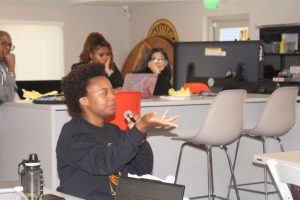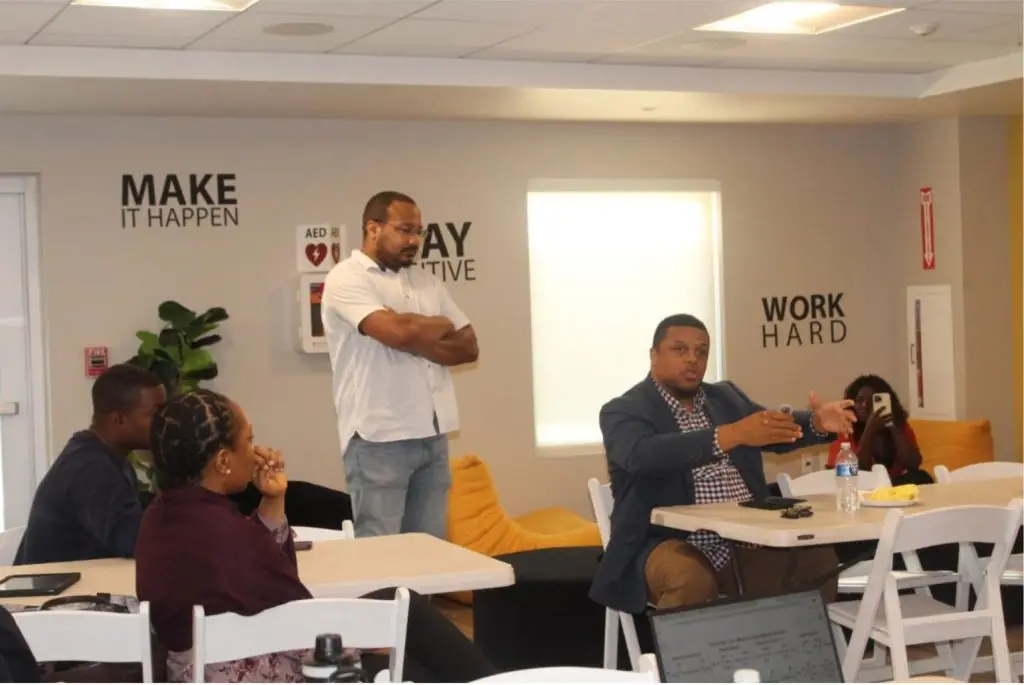
Participants at Charles R. Drew University of Medicine and Science: PC Marion Apio
By Marion Apio | Contributing Writer | California Local News Fellow
Black immigrants in Los Angeles County confront racism and the fear of being deported as they struggle with the economic reality of living in the high-cost region, according to participants in a community forum.
The forum, convened for the upcoming third iteration of the State of Black Los Angeles County report, revealed the unique realities of anti-Black racism in America and, simultaneously, enduring severe legal, linguistic, and economic vulnerabilities for migrants.
“When you’re black, you already have a target on your back, but then when you add the fact that you’re an immigrant, it increases the likelihood of you getting deported if you come in contact with law enforcement or with ICE,” said Jelani Hendrix with the Los Angeles County Anti-Racism, Diversity, and Inclusion Department.
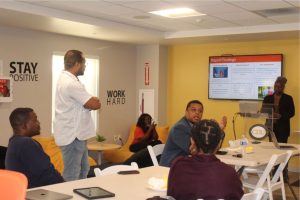
Hendrix was among the county representatives who met a small group of residents, researchers, and local organizers at the June 18 forum at Charles R. Drew University of Medicine and Science in Willow Brook, an unincorporated area of Los Angeles County.
The focus of the forum was to gather qualitative data for the State of Black Los Angeles County report, which will feature an entire chapter dedicated to Black immigrants for the first time.
Participants detailed how federal immigration policies and local systemic inequities intersect to create an intense, daily state of fear among residents with two or multiple identities.
In mixed-status households – where at least one family member is undocumented – the constant threat of separation has forced families to quietly draft emergency exit plans or look into rapidly liquidating local assets.
Beyond targeted enforcement, community leaders emphasized that local government and corporate systems systematically exclude Black immigrants through institutional blind spots. Language barriers remain a glaring issue.
“Everyone that’s an immigrant doesn’t speak Spanish,” Hendrix noted. “Some of us speak Haitian Creole and many other languages, and we need to make sure that as a county, as a country, we provide that language access for those who need it.”
Compounding this isolation is a deep digital divide that locks many families out of vital public services and legal updates entirely.
Khalid Hudson, an advocacy manager with the Council on American-Islamic Relations, Greater Los Angeles Area office, raised concerns about widespread internet inaccessibility
Basic technological disparities leave many local households functionally cut off, preventing vulnerable residents from accessing online legal defense resources, know-your-rights documentation, and virtual support networks, Hudson informed officials.
The psychological and structural toll falls heavily on the younger generation.
Focus group speakers added that families face intense internal pressures, navigating a reality where children cannot afford to make normal mistakes without facing disproportionate tracking into the criminal justice system.
Jathan Melendez, a lead youth organizer with Community Coalition, spoke on the specific challenges students face in South Los Angeles.
“The compounding stress of the immigration crisis forces many young people into adult roles, creating severe disruptions to their education and household stability that local school systems are currently unequipped to handle,” Melendez said.
Despite these intense challenges, participants remarked on the enduring draw of the region, noting that California possesses a robust network of safety nets, even if they remain frustratingly difficult to reach.
Channing Martinez, a Leimert Park resident and co-director of the Labor/Community Strategy Center, emphasized that while the state offers specialized legal, municipal, and grassroots resources not found elsewhere in the country, navigating the institutional barriers remains a major hurdle.
Martinez noted that aggressive local advocacy is required to ensure working-class Black migrants can actually access these lifelines through the existing bureaucratic maze.
State of Black LA Community Forum: PC Marion Apio
The focus group tied resident experiences back to broader structural data and physical conditions in Black neighborhoods.
TeNita Ballard, a county consultant who facilitated the session, explained the importance of bringing county data back to the streets to get direct feedback. She noted the next report will expand to include older Black adults, women and girls, and migrants.
As an example of how data can drive policy, Ballard recounted driving past a local junior high school and seeing students congregated on the playground beneath a single shade tree.
”That really made me sad,” Ballard said. “ How could I, as a resident of that community, advocate for those students?
“When we think about diversity, equity, and inclusion,” she added, “are we not only advocating for our people, but the communities that we live in as well? They deserve to be at school in a shaded area.”
The testimonies collected at the university will be utilized by the county to shape policy and funding allocations.
The upcoming report chapter aims to serve as a catalyst for local governments to better distribute specialized resources, improve language and digital access, and strengthen safety nets for the region’s diverse Black immigrant community.