
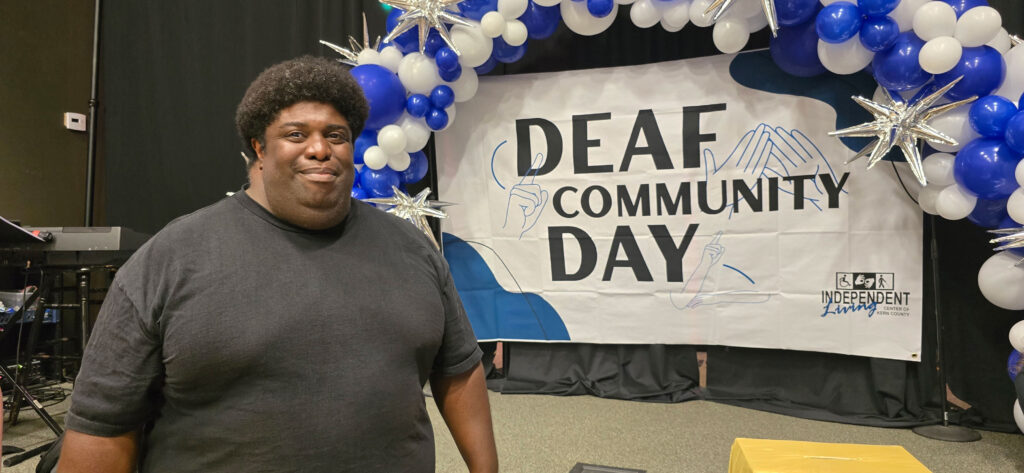

Candice Goodie was born deaf. Growing up in an African-American home, she enjoyed music, danced, and lived life much like her hearing peers. With the help of hearing aids, she could listen to her favorite songs. But that changed in college when her hearing aids began to fail.
“When I was younger, I always wanted to be a hearing person because I enjoyed music. I liked listening and I loved to dance. But when I got into college and my hearing aids stopped working, I realized I couldn’t hear anything anymore,” she recalled.
That realization set her on a new path. Today, Goodie is an American Sign Language (ASL) instructor and advocate for the Deaf community.
The 6th Annual Deaf Community Day in Bakersfield provided a platform for Goodie and others to celebrate ASL and showcase resources for the region’s Deaf and hard-of-hearing residents. Organized by the Independent Living Center of Kern County, the event brought together dozens of organizations, service providers, and advocates. Every presentation was offered in ASL, with interpreters ensuring communication equity.

Bakersfield College’s Sign Language Program was among the exhibitors. The program has been training students for years, helping them communicate effectively with the Deaf community and pursue careers in interpretation. “Many hearing people want to learn ASL for different reasons,” said Tom Maron, an ASL professor at the college. “Some may have a Deaf family member, some may simply want to learn a new language. A student can take ASL for two years and know enough to hold conversations with a stranger.”
One of those learners is Afaha Udoh, a Nigerian-American. His introduction to the Deaf community began on a volleyball court, where he struggled to communicate with two Deaf teammates by scribbling notes back and forth. What started as a practical solution soon became a passion.
“I started learning ASL because I had two friends on my volleyball team, one Deaf and the other hard of hearing, and we were wasting paper writing everything down,” Udoh said. “Then I learned to sign and fell in love with the language.”
Udoh’s fluency deepened as he immersed himself in Deaf spaces. “Just like any other language, you need the community. There’s the classroom way of learning, and then there’s the community way. If you don’t learn from the community, you miss the language itself,” he said.

For others, learning ASL is driven by professional necessity. Dee English, a nurse and interpreter with Deaf Family Socials, said her motivation was to close communication gaps in healthcare.
“I’m a nurse, and I have a lot of Deaf patients who come into the hospital. Sometimes they feel alone, waiting for an interpreter. They’re already scared, and then they can’t communicate. I thought, you know what? I can learn sign language. That way, I can let them know what’s happening,” English said. She added that the Deaf community always appreciates when people make the effort to learn.
Faith communities are also finding ways to connect. At Laurelglen Bible Church, leaders provide weekly services in ASL. “We offer a Deaf Church for those who can’t hear or are hard of hearing. Many don’t have a way to connect to a church because they don’t understand. Every Sunday at 10 a.m., our pastor signs the full service, with an interpreter available for those still learning,” said a church representative. The church also supports a Deaf congregation in Haiti, where children are often stigmatized as “cursed.” In addition to worship, they run a school to help those children become productive members of society.
Technology companies are also stepping in. One booth that drew attention was ZP Better Together, which demonstrated an app allowing Deaf users to make calls through a live video interpreter. “You just type in the number and you’re ready to go. The interpreter pops up on screen and facilitates the conversation in real time,” explained Tarun Manchanda, a regional account manager. The service operates 24 hours a day and is available in both English and Spanish.
Attendees at the Deaf Community Day shared with the Bakersfield News Observer some common misconceptions about Deaf people.
Goody: “Hearing people sometimes think Deaf people can’t do things like drive, work, or see a doctor. But Deaf people are capable of everything except hearing.”
Udoh: “This is a joke I hear all the time. Yes, Deaf people are quiet, but they’re also so loud.”
English: “A lot of hearing people have never met a Deaf person. They imagine Deaf people can’t do what hearing people can. That’s simply not true.”
For Udoh, the future lies in activism, raising awareness about Deaf culture in Nigeria and beyond. For Goody, it is about teaching Deaf people self-advocacy and encouraging them to claim space. For English, it means urging more hearing people to learn ASL. Each, in their own way, is pushing for a society where people meet one another halfway, one sign at a time.
At the end of the day, the message from the Deaf Community Day was loud and clear: hearing people should meet the Deaf halfway by learning Sign Language, embrace the Deaf culture, and prove that inclusion is more than a slogan, it is action.
Cecil Egbele is a California Local News Fellow.
