
facebooktwitterinstagram
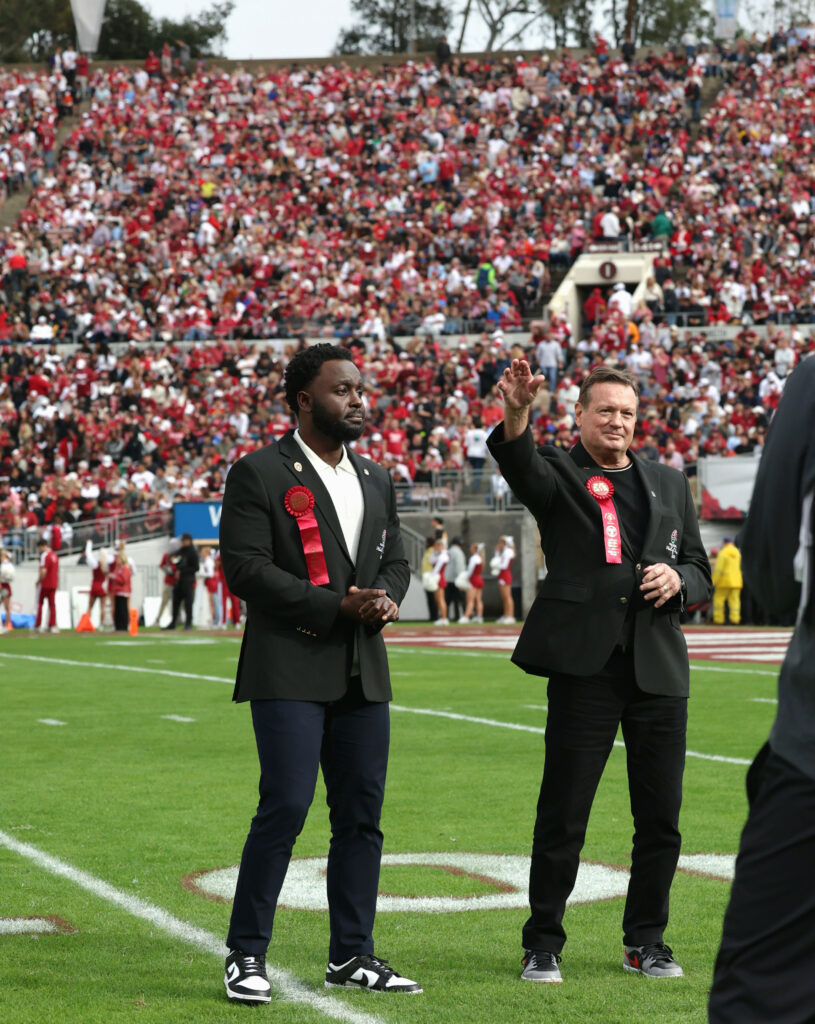
Two figures whose performances helped define the Rose Bowl’s modern era — one from the sideline, the other from the backfield — were honored in Pasadena as Bob Stoops and Montee Ball were inducted into the Rose Bowl Hall of Fame.
By Earl Heath | Contributing Sports Writer
Two figures whose performances helped define the Rose Bowl’s modern era — one from the sideline, the other from the backfield — were honored in Pasadena as Bob Stoops and Montee Ball were inducted into the Rose Bowl Hall of Fame.
The ceremony was held at The Langham Huntington Hotel, just miles from the iconic stadium where both men left lasting legacies. Their inductions bring the Hall of Fame’s membership to 148 individuals over its 37-year history, with honorees recognized by plaques in the Rose Bowl Stadium’s Court of Champions.
Stoops’ Championship Pedigree
Bob Stoops built one of the most successful coaching résumés in college football history during his tenure at the University of Oklahoma. From 1999 to 2016, Stoops compiled a remarkable 190–48 record and guided the Sooners to the 2000 national championship.
His Rose Bowl moment came following the 2002 season, when Oklahoma defeated Washington State 34–14 in the 2003 Rose Bowl. Under the Bowl Championship Series rules in effect at the time, the Sooners were selected as a replacement for Big Ten champion Ohio State, which advanced to the Fiesta Bowl to face Miami for the national title.
Stoops’ accomplishments extend beyond that single game. He remains the only coach in college football history to win a national championship and all four BCS bowl games — the Rose, Orange, Sugar and Fiesta bowls — a distinction that underscores his consistency on the sport’s biggest stages.
Uniquely, Stoops is also among just 11 individuals to have both played in and coached a team in the Rose Bowl. As a player, he was a starting defensive back for Iowa in its 28–0 loss to Washington in the 1982 Rose Bowl.
Stoops retired as Oklahoma’s winningest coach in 2017 at age 56 and was succeeded by then-offensive coordinator Lincoln Riley. He later returned briefly to the sideline as interim head coach, leading the Sooners to a 47–32 victory over Oregon in the 2021 Alamo Bowl following Riley’s departure to USC.
Ball’s Rose Bowl Brilliance
Montee Ball carved out a place in Rose Bowl history with a combination of power, speed and consistency that few players have matched.
Ball is the only player ever to rush for at least 100 yards in three Rose Bowl Games. He ran for 132 yards and a touchdown in Wisconsin’s 21–19 loss to TCU in the 2011 Rose Bowl, followed by 164 yards in a thrilling 45–38 loss to Oregon in the 2012 game. He capped the trio with a 100-yard performance against Stanford in a 20–14 loss.
His running style was electric — capable of turning on the jets and stopping on a dime — and made him a centerpiece of Wisconsin’s offense during one of the program’s most successful stretches.
In recognition of his impact, Ball was named to the Rose Bowl Game All-Century Class as the representative of the 2010s, announced in conjunction with the 100th Rose Bowl Game in 2014.
The Rose Bowl Hall of Fame honor marks Ball’s second induction this month. On Dec. 9, he was also inducted into the College Football Hall of Fame, further cementing his legacy as one of the game’s elite running backs.
A Shared Place in Rose Bowl History
Though their paths to Pasadena glory were different, Stoops and Ball share a common thread — excellence on college football’s most storied stage. Their inductions celebrate not just wins and statistics, but the enduring role the Rose Bowl plays in shaping legends of the sport.
As their names are added to the Court of Champions, both men take their place among the figures who have helped make “The Granddaddy of Them All” a centerpiece of college football history.