
facebooktwitterinstagram
You can be driving down a two-lane road, radio low, coffee cooling in the cup holder, when a green highway sign suddenly asks you a question you were not prepared to answer. Why. Just that. Why. Arizona.
By Stacy M. Brown | NNPA Newswire Senior National Correspondent
You can be driving down a two-lane road, radio low, coffee cooling in the cup holder, when a green highway sign suddenly asks you a question you were not prepared to answer. Why. Just that. Why. Arizona.
In that moment, America tilts its head and smiles.
“I chase light and landscapes, but the names are what stop people in their tracks,” said Charles Rouson, a documentary photographer who has spent years shooting roadside America. “You see a sign that says Accident or Why, and suddenly the picture takes itself.”
The United States is a country that takes its geography seriously until it absolutely does not. Between the coasts and across the plains, town names tell stories that history books skip and road maps whisper. Some are accidents. Some are jokes that went too far. Some are quiet acts of rebellion by people who figured if they were going to live out here, they might as well have some fun with it.
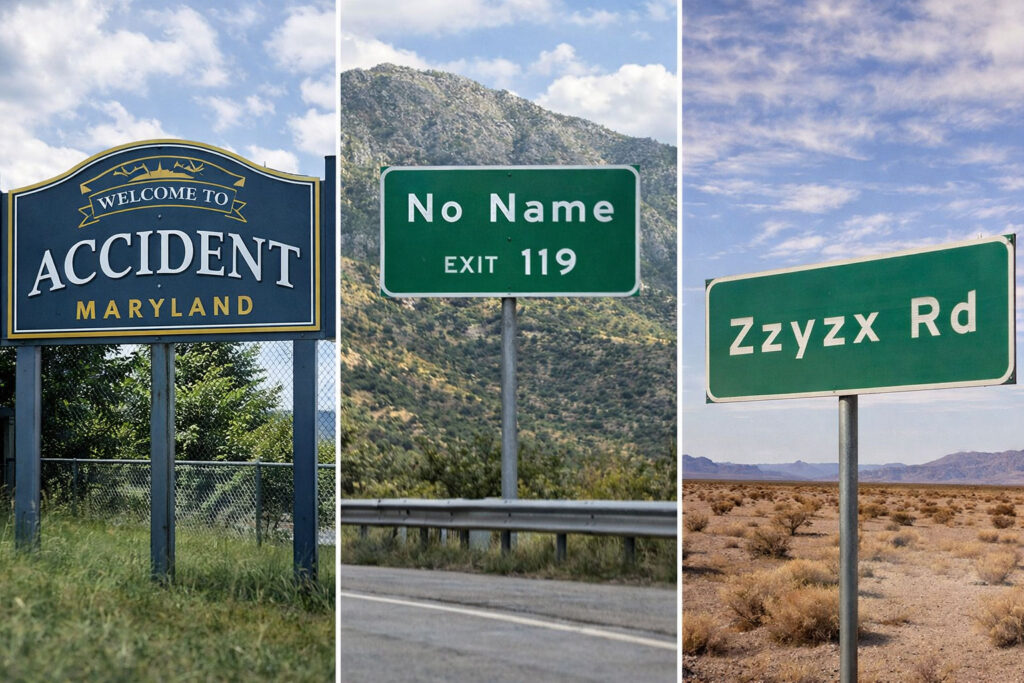
Take Accident, Maryland. It sounds like a place you hope never to visit, yet it sits calmly in Garrett County, surrounded by trees, lakes, and the kind of scenery that makes you slow down without meaning to. The name did not come from disaster but from a surveying dispute in the 1700s. Two land claims overlapped, and someone wrote down the word accident. The name stayed. The town did too.
Then there is Truth or Consequences, New Mexico, a place that sounds like a warning and a dare at the same time. In the 1950s, a radio show promised to broadcast from the first town willing to rename itself after the program. The town raised its hand. The broadcast ended. The name remained. Decades later, the sign still stands, reminding travelers that sometimes America leans into the bit and never lets go.
“Place names are the fingerprints of history,” said Ian Dayley, a geographer who studies American settlement patterns. “They tell you who had the power to name something, what mattered in that moment, and how little anyone cared about explaining it to the future.”
Out west, California offers Zzyzx, a name that looks like a keyboard malfunction and sounds like a secret code. It was coined by a health resort promoter who wanted the last word in the dictionary. He got close enough. Today, Zzyzx sits quietly near the Mojave Desert, proof that ambition and odd spelling can leave a permanent mark.
The Midwest does not shy away either. There is Normal, Illinois, a town that decided the safest thing to be was exactly that. Nearby, Sandwich, Illinois reminds visitors that not every name is about food, even when it sounds like it should be. In Ohio, Knockemstiff carries a reputation that locals have spent generations explaining, denying, and occasionally leaning into.
Down South, the names start to sound like porch conversations that got written down and never corrected. Lick Skillet, Alabama. Possum Trot. Burnt Corn. Each one feels like a sentence fragment pulled from a longer story that everyone else already knows. In Tennessee, Sweet Lips sits quietly, while in Kentucky, Monkey’s Eyebrow refuses to explain itself at all.
Texas, never content to be subtle, offers Ding Dong, Cut and Shoot, and Kermit. Each one has a backstory rooted in families, feuds, or frontier humor that did not worry much about how it would sound a hundred years later. In Oklahoma, Okay makes the point without elaboration.
Some towns turn the joke into a business plan. Santa Claus, Indiana answers letters every year from children who believe the postmark means something. Hell, Michigan sells souvenirs, wedding packages, and one square inch of property, because if people are going to tell you to go there, you might as well monetize it.
Others are quieter about it. No Name, Colorado sits near a creek and a canyon with the same label, a shrug turned into geography. Why, Arizona exists because the law required more than one letter, and someone decided existential humor was the best solution.
What ties these places together is not silliness but ownership. These names survived because the people who live there kept them alive. They put them on water towers, school jerseys, and welcome signs. They explain them to newcomers. They correct pronunciations. They defend them when outsiders laugh too hard.
In a country that often argues over identity, these towns settled the question early. This is who we are. This is what we called it. You can laugh if you want, but slow down. You might like it here.
And somewhere between Accident and Why, between Truth or Consequences and No Name, America tells you exactly what it is. Complicated. Unapologetic. Occasionally ridiculous. Always convinced that the story is better when you leave the name exactly as it is.
“These towns remind us that the map is not just data,” said Christine Amato, a cultural historian who focuses on rural America. “It is memory, humor, stubbornness, and the quiet confidence to say this is who we are.”