
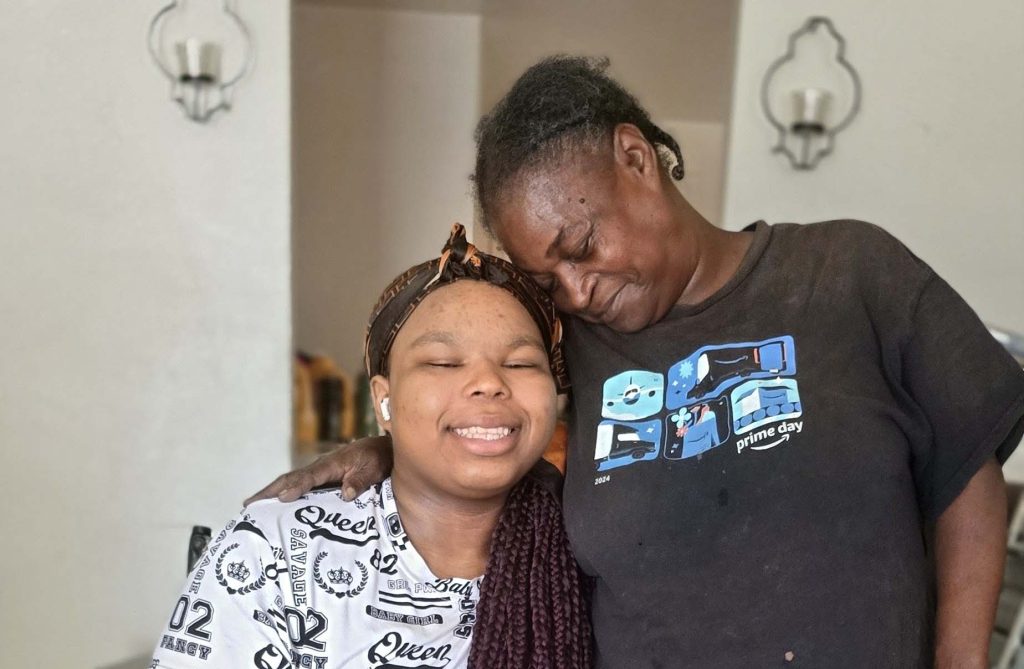

This story was produced for the USC Center for Health Journalism’s Ethnic Media Collaborative.
By Cecil Egbele | Contributing Writer | California Local News Fellow
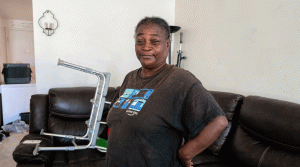
Angela Hagler’s Shafter townhome, about 13 miles outside Bakersfield, includes basic household furnishings, other than a bench in the living room the 57-year-old uses to lift her 16-year-old granddaughter into a bathtub specially outfitted for amputees.
On this day, Hagler sat on a brown sofa in a loose T-shirt, printed pajama pants, and house shoes. She had not left the townhome that day. Sarabhi Vaughn, Hagler’s granddaughter, sat across the dimly lit room.
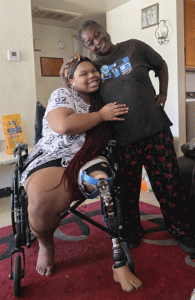
Hagler and Vaughn said that on Aug. 13, 2024, Vaughn, who was then 14, was standing in a yard on Wilson Road, Bakersfield, when she was struck by a vehicle. They declined to comment further because an associated lawsuit is ongoing.
Bakersfield News Observer
Get Bakersfield news that speaks to us.
The stories Kern County's Black community needs, in your inbox every Wednesday. Free.
Free weekly newsletter. Unsubscribe anytime.
In the aftermath of the crash, Vaughn’s leg was amputated. Hagler– who was already struggling to keep her job at Amazon after a workplace injury left her employment status uncertain– now spends more than 12 hours a day tending to the teen’s physical and emotional needs, with little time or energy left for her own.
Hagler insists she’s “fine,” even as she describes isolation, financial hardship and anxiety — all symptoms consistent with caregiver burnout. She recognizes the toll caregiving is taking on her. But recognizing she needs help and asking for it are two different things.
“I know depression when I see depression,” Hagler said. “I make it happen, you know? I’m alright.”
According to the 2025 Caregiving in the U.S. report, there are 63 million family caregivers in the nation, many of whom are caring for a loved one at the expense of their own mental health. Experts say the people providing care are often the least likely to seek it for themselves because their attention is constantly directed toward someone else.
“I used to go visit Bakersfield two or three times a week, but I don’t do that now. I stay home with her,” Hagler said of her granddaughter. “I feel depressed because my way of living has changed, I see that I’m staying more inside. Caregivers don’t have breaks.”
The caregiver report, released by AARP and the National Alliance for Caregiving, found widespread emotional, financial, and health strain among the nation’s family caregivers. Two-thirds of caregivers report moderate to high emotional stress, and one in four report feeling socially isolated.
Bakersfield resident Ucedrah Osby, who has known Hagler for 20 years, recalled the transformation her best friend has undergone in the wake of assuming her full-time caregiving role.
“Angela used to be very bubbly, very social. Happy about life. Her skin used to be glowing,” Osby said. “She would take pride in, you know, dressing up, her hair, her eyelashes; she would even get her nails done.
“She was the life of the party. Always willing to share wisdom with young people and with the parents. Always being helpful. And now those things are a thing of the past,” Osby added.
Theodore Richard, a clinical social worker who has not consulted with Hagler, said caregivers may resist help because they are experiencing burnout or because they believe no one else can provide care the way they can.
“A lot of times they don’t feel like they need help because they’re almost in ‘survival mode,” Richard said.
He said caregivers might shy away from pursuing outside support because of cultural, personal, or other reasons.
He said caregivers may have the attitude of, “we’re just going to deal with this in-house.”
In California, more than 7 million adults serve as family caregivers. These caregivers are not simply helping an elderly parent get to a doctor’s appointment. Many are helping loved ones bathe, dress, eat, move around the house, and manage medications.
After Hagler’s daughter, Mayisha Dale, died in 2021, Hagler became Vaughn’s unofficial guardian. Hagler took responsibility for getting Vaughn through the emotional aftermath of losing a parent. Then came the 2024 car crash.
Hagler schedules Vaughn’s medical and physical therapy appointments and attends every appointment across Los Angeles, Bakersfield, and Madera.
She also navigates the bureaucracy of scheduling special medical transport that can accommodate a wheelchair or walker, which requires 48 hours to a week of advance notice.
Hagler is also in charge of taking Vaughn to pick up her weekly schoolwork at Shafter High School and ensuring Vaughn completes her assignments on time.
Hagler prepares their meals, helps Vaughn get in and out of the shower, and enforces the teen’s daily routine of using her prosthetic leg so she can regain her mobility.
And then there’s the ongoing emotional support of helping a teenager through the isolation and pain of losing a leg and her life as she knew it.

Hagler supports the teen through bouts of self-pity and depression. She encourages her to go out and socialize with friends — something the teen did recently after more than two years largely trapped indoors.
After the crash, Vaughn was hospitalized for months, undergoing multiple surgeries. Doctors tried to save her left leg, but ultimately she underwent an above-the-knee amputation.
Hagler said hospital staff became concerned about Vaughn’s depression and possible suicidal thoughts.
Now Hagler said she recognizes when Vaughn is depressed and works to pull her out of it. Hagler’s own dark moods are harder to address.
“I know that I’m going through depression right now,” Hagler said. “Now I’m just looking at four walls. I have no energy to do anything. I get up but go nowhere.”
When asked how she takes care of herself, Hagler replied, “I literally don’t.”
The AARP caregiving report said nearly one in five family caregivers report being in fair or poor health, and nearly one in four say caregiving makes it difficult to care for their own health.
Hagler and Vaughn acknowledged the stress can lead to them arguing and retreating to their respective bedrooms to process and calm down. While Hagler watches Chinese TV dramas, Vaughn enjoys TV soaps and series until the air clears. That is how they cope.
Vaughn said she understands the plight of her grandmother.
“My grandma is taking care of me by herself,” she said. “And now I’m hurt, and she’s hurt.”
Hagler said caring for family is much different than the paid care work she has done previously.
Hagler used to work as a caregiver, taking care of a range of people from those with ADHD to the severely disabled.
“If I was taking care of somebody else, I could go take care of them and go home,” she said.
“This is not a job. This is life,” she added.
When Trust, Survival and Support Collide
Hagler, who is unable to work because of her caregiving responsibilities and work injury, has the option of seeking out assistance from programs through In-Home Supportive Services (IHSS) that pay family caregivers.
But she has so far declined to pursue that help.
“A lot of people were doing scams,” she said. “I don’t know who to talk to about that, because I don’t trust a lot of people.”
Hagler underwent shoulder surgery after she was injured on her Amazon job. Later, she developed numbness in her hand. Doctors have also been treating problems with her neck.
Hagler said she has been told she may be permanently disabled and will need to begin the process of applying for Social Security disability benefits.
The IHSS, a decades-old, state-administered program, could provide benefits.. Her granddaughter had been assigned an IHSS-authorized in-home care worker for about 16 hours a month. But this caregiver has been on maternity leave for about 10 months now, and Hagler has not applied for a replacement.
Hagler could be compensated for the care she is providing seven days a week — currently without pay — if her granddaughter is eligible and the county assessment authorizes those services.
“They have to be Medi-Cal,” said Jeremy Oliver, the director of Kern County Aging and Adult Services. ”Our in-home support service program is Medi-Cal based, which offers actual caregiver support assuming that they meet the criteria.”
Oliver said the agency also offers family caregiver support through California Area Agency on Aging. The Waiver Personal Care Services (WPCS), a state program that provides additional personal-care services, is another possibility. It is available to people enrolled in the Home and Community-Based Alternatives Waiver who are also receiving IHSS and whose doctors determine that the additional services are necessary for them to remain safely at home.
A family member can potentially become a WPCS provider after completing the IHSS provider-enrollment process.
Getting help in the short-term is one thing. Hagler wonders about the longer-term future for her and her granddaughter.
The IHSS program partners with support groups like the Valley Caregiver Resource Center to help people like Hagler feel a sense of community with others who understand the toll of being a caregiver.
But she rejected the idea.
“I don’t think I need it,” she said. Her granddaughter disagreed.
“You are not okay,” she told her grandmother. “You’ve lost a job. You have your own health issues.”
Hagler said the kind of assistance she needs is different.
“The help I need is if somebody could pay my rent. Somebody could pay my PG&E. Somebody could buy me some groceries,” she said. “That’s the kind of help that I would need.”
She also questioned what a mental-health professional could do for her beyond telling her to slow down or prescribing medication.
Richard, the clinical worker, said if Hagler had the financial means to pay her bills, that would remove one source of stress.
“If she had the means to take care of it, that would be one less thing that she would have to worry about.”
He added that therapy itself does not fix any problems outright.
“It’s not about the therapist telling them what to do, but helping them come into a conclusion of what works best for them and how they can address it,” he said.
Oliver said caregivers like Hagler can call his office to discuss their circumstances and be connected with appropriate resources.
“We just need to know a little bit more about what the circumstances are, what she’s struggling with, and try to link her to the right source,” Oliver said.
For Hagler, the question now is whether she will pursue some of the help she didn’t know was available and whether accepting it could give her something she has struggled to find since becoming her granddaughter’s caregiver: relief.
She said she is willing to look into the assistance, not because she wants to step away from caring for her granddaughter, but because she wants to be able to keep doing it.
“Regardless of how I got to take care of her, what situation comes, as long as you leave her here, I’m going to take care of her,” she said.
