By Marion Apio | California Local News Fellow
Housing costs, food insecurity, consumer debt and uncertainty over health care coverage are straining families in Los Angeles’ 43rd Congressional District, experts said during an Oct. 10 town hall at Los Angeles Southwest College. Experts outlined residents’ challenges and available services.
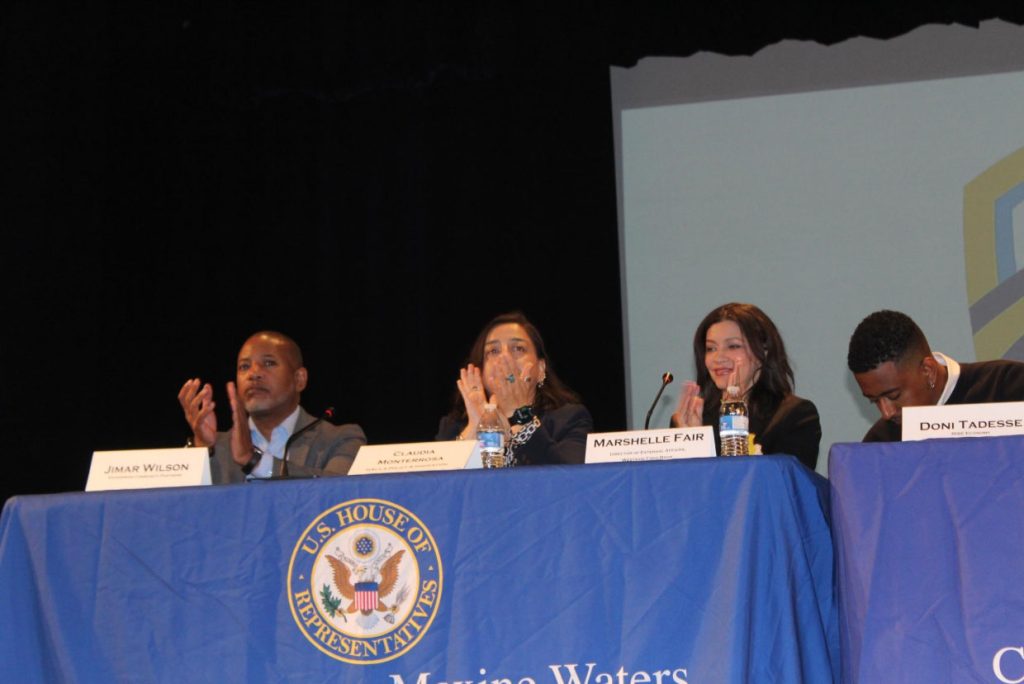
Convened by U.S. Rep. Maxine Waters, the town hall brought together representatives from housing organizations, a food bank, a financial advocacy group, community health services, the county elections office and an immigrant legal services organization. They discussed how rising costs and policy changes affect families’ ability to afford necessities, maintain health coverage and protect their finances.
Michelle Fair, director of external affairs for Westside Food Bank, said the organization supplies food to more than 60 partner agencies and operates five mobile markets. Distributions include rice, beans, canned tuna, eggs and fresh produce.
Free groceries allow households to redirect limited income toward rent, utilities, medication and school supplies, Fair said. She recalled speaking with three mothers in one day who said food assistance helped them pay rent and avoid losing their homes.
Westside Food Bank was seeing twice its usual demand at partner agencies and direct distributions, Fair said. Those seeking assistance include working parents with multiple jobs, seniors on fixed incomes, veterans and college students. Some students ate just one meal a day, while others lived in their cars.
Fair said the organization was exploring additional mobile markets to reach more residents, particularly in neighborhoods with limited grocery access.
“Frankly, no one should go to bed hungry,” she said.

Financial pressures can also push households toward costly borrowing, said a representative of Rise Economy, formerly the California Reinvestment Coalition. The organization works to improve financial services for low-income communities, including Black and Indigenous families affected by discriminatory lending practices.
The speaker identified overdraft fees, payday loans, check-cashing services and buy-now, pay-later plans as potential sources of financial strain. Borrowers who use loans to cover immediate expenses may struggle to repay them while facing the same bills the following month.
Payday loans can carry annual percentage rates of 300% to 400% or more, depending on the product and fees, the speaker said. The representative also raised concerns about consumer data used to tailor prices and financial products that encourage repeated borrowing.
The speaker urged residents to compare financial products and seek assistance before taking on debt they may struggle to repay. Waters also warned against payday lending, encouraging residents to seek temporary help from trusted community networks instead.
Health coverage was another concern, particularly for people at risk of losing insurance because of missed renewal notices, eligibility changes or incomplete paperwork.
Claudia Romero, a student and family resources coordinator for the Los Angeles Unified School District, said she supervises certified enrollment counselors who help community members navigate insurance applications, renewals and coverage options. The program serves the broader community, not just families with children enrolled in district schools.
Counselors help residents navigate Medi-Cal, California’s Medicaid program, and Covered California, the state’s health insurance marketplace. Romero said changes in income, employment or family circumstances can affect eligibility, so insured residents should seek guidance when their circumstances change.
Residents concerned about disclosing their immigration status can ask questions confidentially without completing an application, Romero said. Counselors also connect callers to mental health assistance and referrals for transportation and housing.
Romero provided the LAUSD Student and Family Resources hotline, 213-241-3840, which directs callers to services based on their ZIP code. She urged residents to update their contact information and track renewal deadlines to avoid coverage interruptions.
Dr. Cosat Lyons Jones, chief medical officer at Watts Healthcare Corporation, said community health centers were preparing patients for anticipated changes to Medicaid eligibility and renewal requirements. People who miss notices, fail to update their addresses or cannot access online systems could lose coverage despite still needing care, she said.
A lapse in coverage can prevent patients from filling prescriptions, completing diagnostic tests or attending follow-up appointments, potentially worsening health conditions and increasing emergency room visits, Jones said.
Watts Healthcare was contacting patients to verify their phone numbers, addresses, email addresses and household information, she said. Jones urged patients to maintain a relationship with a primary care provider and seek enrollment assistance. Clinics may also offer computer access and enrollment help to people without reliable internet service.
Patients who lose insurance or cannot afford care can still seek treatment, Jones said. Watts Healthcare and other safety-net clinics offer sliding-scale services based on patients’ ability to pay, including those with no money available.
The town hall also addressed voting access ahead of the Nov. 3 general election. An election official identified as Logan said Los Angeles County offers voting by mail, secure ballot drop boxes and in-person voting at designated centers.
The official said 29 secure ballot drop boxes were available in the congressional district, including one at Los Angeles Southwest College. In-person vote centers were scheduled to open Oct. 24, with the college site opening Oct. 31.
The county had contingency plans for possible disruptions, the official said, urging residents to rely on trusted sources for voting information. Residents could also work at vote centers for a stipend, including community members and students.
Immigration enforcement and access to legal assistance were also discussed. Laura Diaz, legal director at the Central American Resource Center, said immigration arrests had separated parents from children and disrupted workers’ and families’ lives.
Diaz raised concerns about detention conditions and delays in medical care, saying immigration enforcement must respect due process. She highlighted immigrants’ contributions to agriculture, health care, restaurants and hotels, and urged residents to share legal service information and support affected neighbors.
The Central American Resource Center provides immigration legal services and advocates for social and economic justice, Diaz said. She also directed attendees to a rapid-response service run by the Immigrant Defenders Law Center for people seeking help when someone is detained.
The discussions showed how financial setbacks can affect household stability across multiple areas. Food assistance can free up money for rent, debt can consume funds needed for necessities, and missed health insurance renewals can interrupt medical care. Speakers urged residents to seek help early, keep records and contact information current, and use established service providers rather than rely on unverified information.
Residents seeking health insurance guidance can call the LAUSD Student and Family Resources hotline at 213-241-3840. Those needing food assistance can contact Westside Food Bank about partner agencies and mobile markets. Voters should confirm ballot return locations and voting dates with the Los Angeles County Registrar-Recorder/County Clerk. Those affected by immigration enforcement can seek help from qualified legal service organizations.